Efficient air distribution is essential in commercial, industrial, and residential HVAC systems. When engineers design an HVAC project, one of the most important decisions is choosing the right duct type.
The three most common options are spiral ducts, round ducts, and square (rectangular) ducts — each with different advantages, material usage, airflow performance, and installation costs.
This guide provides a detailed comparison to help contractors, fabricators, and project engineers decide which duct type is most suitable for specific HVAC applications.
.jpg)
Overview of the Three Main Duct Types
Before comparing performance, efficiency, and cost, here is a clear definition of each duct type.
1. Spiral Ducting
Spiral ducts are manufactured by a spiral duct forming machine, which rolls metal strip into a continuous tube with a locked seam.
Common materials: galvanized steel, stainless steel, aluminum.
Typical use: commercial buildings, warehouses, industrial ventilation.
2. Round Ducting
Round ducts are formed from metal sheets rolled into a cylinder, and the edges are joined by a lock seam or welding.
Common use: residential HVAC, low-pressure ventilation, general air distribution.
3. Square (Rectangular) Ducting
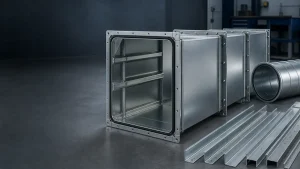
Square ducts are fabricated from sheet metal panels bent and joined using Pittsburgh seams or flanges.
Common use: low-clearance spaces, commercial HVAC, large airflow systems.
Performance Comparison — Spiral vs. Round vs. Square Ducts
To help engineers choose efficiently, the following sections compare airflow, leakage, installation, space usage, noise level, and total cost.
1. Airflow Efficiency
Spiral Ducts — ★★★★★
Smooth interior
Low friction loss
Minimal turbulence
Best for long-distance ventilation
Round Ducts — ★★★★★
Similar efficiency to spiral ducts
Ideal for small-to-medium air volume
Square Ducts — ★★★☆☆
Edges create turbulence
Higher friction loss
Requires larger fans or higher power
Winner: Spiral & Round Ducts
2. Air Leakage Performance
Spiral Ducts
Seam is tightly locked
Typically lowest leakage rate
Excellent for energy-efficient HVAC systems
Round Ducts
Good sealing performance
Depends on seam quality
Square Ducts
Highest leakage rates due to corners and joints
More sealant and tape required
Winner: Spiral Ducts
3. Strength & Durability
Spiral Ducts
Built-in reinforcement from the spiral seam
Can withstand higher pressures
Best rigidity
Round Ducts
Good strength
May require reinforcement for large diameters
Square Ducts
Weakest structural strength
Needs external reinforcement (angles, bars)
Winner: Spiral Ducts
4. Installation Speed & Labor Cost
Spiral Ducts
Long continuous lengths reduce joints
Lower installation time
Less leakage → less sealing work
Round Ducts
Moderate installation speed
Lightweight and easy to handle
Square Ducts
Slowest installation due to complex assembly
More labor and accessories required
Winner: Spiral Ducts
5. Space Requirement & Clearances
Spiral Ducts
Space-efficient but require consistent radius
Round Ducts
Fit easily in open ceiling applications
Square Ducts
Best for narrow ceiling or low-height conditions
Can fit tight architectural spaces
Winner: Square Ducts (for clearance-constrained areas)
6. Noise Level
Spiral Ducts
Quiet operation due to smooth airflow
Low vibration radius
Round Ducts
Similar low-noise characteristics
Square Ducts
More turbulence → higher noise
Winner: Spiral & Round Ducts
7. Material & Production Cost
Spiral Ducts
Efficient material usage
Lower cost for medium-to-large projects
Produced quickly using spiral duct forming machines
Round Ducts
Moderate cost
Dependent on sheet rolling processes
Square Ducts
Highest material cost
More accessories (flanges, frame, reinforcements)
Winner: Spiral Ducts (cost–performance best ratio)
Summary Comparison Table (Spiral vs. Round vs. Square Ducts)
| Feature | Spiral Duct | Round Duct | Square Duct |
|---|---|---|---|
| Airflow Efficiency | ★★★★★ | ★★★★★ | ★★★☆☆ |
| Leakage | ★★★★★ | ★★★★☆ | ★★★☆☆ |
| Strength | ★★★★★ | ★★★★☆ | ★★★☆☆ |
| Installation | ★★★★★ | ★★★★☆ | ★★☆☆☆ |
| Space Saving | ★★★★☆ | ★★★★☆ | ★★★★★ |
| Material Cost | ★★★★★ | ★★★★☆ | ★★☆☆☆ |
When Should You Choose Each Duct Type?
Choose Spiral Ducting When:
You need high efficiency and low leakage
The project is industrial or commercial
You want fast installation
Energy savings are a priority
Aesthetic exposed ducts are required
Recommended for: warehouses, factories, malls, airports
Choose Round Ducting When:
Air volume is moderate
Budget is limited
Used for residential or basic ventilation
Recommended for: homes, small shops, general ventilation
Choose Square Ducting When:
Building has low ceiling height
Space is constrained
Customized shapes are required
Recommended for: office buildings, tight ceiling spaces
Role of Spiral Duct Forming Machines in Modern HVAC Projects
Spiral ducts have become increasingly popular due to:
Higher airtightness
Faster production
Consistent quality
Lower cost
Modern spiral duct forming machines enable high-speed duct production for large-volume HVAC projects.
FAQ — Spiral vs. Round vs. Square Ducting
Q1: Which duct type has the best airflow?
Spiral and round ducts offer the best airflow with minimal friction loss.
Q2: Is spiral duct more expensive than square duct?
No. Spiral ducts usually cost less due to reduced material and faster installation.
Q3: Why do many commercial buildings use spiral ducts?
They offer excellent strength, low leakage, and aesthetic exposed appearance.
Q4: Are square ducts outdated?
No, they are still necessary for tight ceilings and architectural constraints.
Q5: Which duct type is best for energy efficiency?
Spiral ducts due to their superior sealing and lower airflow resistance.