Choosing between a 45 degree elbow and a 90 degree elbow is a small decision with real consequences — it directly affects airflow resistance, pressure drop, and how much space your ductwork or piping system requires. This guide breaks down the key differences so you can match the right elbow to your specific layout and performance needs.
1.What Is a Pipe Elbow?
A pipe elbow is a fitting used to change the direction of a pipeline. Whether routing air through HVAC ducts, water through supply lines, or gas through industrial systems, elbows allow pipelines to navigate corners, obstacles, and elevation changes. The two most common types are the 45 degree elbow and the 90 degree elbow, though specialty angles (22.5°, 60°) exist for complex installations.

2.What Is a 45 Degree Elbow?
A 45 degree elbow redirects flow at a gentle 45° angle — half the sharpness of a right-angle turn. This gradual curve minimizes turbulence, reduces pressure loss, and lowers the energy demand on fans and pumps. In HVAC systems, this translates directly to quieter operation and lower electricity bills.
Common sizes range from ½” to 24″ in diameter. Two 45 degree elbows can also be combined to achieve a 90° turn with significantly less flow resistance than a single 90° elbow.

3.What Is a 90 Degree Elbow?
A 90 degree elbow makes a sharp right-angle turn — the most space-efficient way to change pipe direction. It is the most widely used elbow in construction and plumbing precisely because it keeps installations compact and straightforward. The trade-off is higher flow turbulence, which matters more in pressurized systems than in gravity-fed drains.

4. Key Differences: 45 Degree Elbow vs 90 Degree Elbow
| Feature | 45 Degree Elbow | 90 Degree Elbow |
|---|---|---|
| Bend Angle | Gentle 45° curve | Sharp 90° right angle |
| Flow Resistance | Low — less turbulence | Higher — more turbulence |
| Space Required | More linear space needed | Compact, saves space |
| Best For | HVAC ducts, pressurized supply lines | Drains, tight corners, gravity systems |
| Typical Installation | Often paired for custom angles | Used alone for right-angle turns |
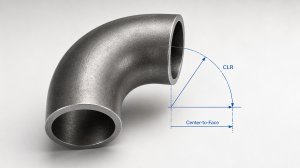
5.Standard Dimensions of 45° vs 90° Elbows
| Nominal Pipe Size (NPS) |
Outside Diameter at Bevel (OD) |
Center to End | ||
|---|---|---|---|---|
| Long Radius Elbow | Short Radius Elbow | |||
| 90 degree. A | 45 degree B | 90 degree A | ||
| 1/2 | 21.3 | 38.1 | 15.7 | - |
| 3/4 | 26.7 | 38.1 | 19.1 | - |
| 1 | 33.4 | 38.1 | 22.4 | 25.4 |
| 1-1/4 | 42.2 | 47.8 | 25.4 | 31.8 |
| 1-1/2 | 48.3 | 57.2 | 28.4 | 38.1 |
| 2 | 60.3 | 76.2 | 35.1 | 50.8 |
| 2-1/2 | 73.0 | 95.2 | 44.4 | 63.5 |
| 3 | 88.9 | 114.3 | 50.8 | 76.2 |
| 3-1/2 | 101.6 | 133.4 | 57.2 | 88.9 |
| 4 | 114.3 | 152.4 | 63.5 | 101.6 |
| 5 | 141.3 | 190.5 | 79.2 | 127.0 |
| 6 | 168.3 | 228.6 | 95.2 | 152.4 |
| 8 | 219.1 | 304.8 | 127.0 | 203.2 |
| 10 | 273.1 | 381.0 | 158.8 | 254.0 |
| 12 | 323.9 | 457.2 | 190.5 | 304.8 |
| 14 | 355.6 | 533.4 | 222.2 | 355.6 |
| 16 | 406.4 | 609.6 | 254.0 | 406.4 |
| 18 | 457.2 | 685.8 | 285.8 | 457.2 |
| 20 | 508.0 | 762.0 | 317.5 | 508.0 |
| 22 | 558.8 | 838.2 | 342.9 | 558.8 |
| 24 | 609.6 | 914.4 | 381.0 | 609.6 |
| 26 | 660.4 | 990.6 | 406.4 | 660.4 |
| 28 | 711.2 | 1066.8 | 438.2 | 711.2 |
| 30 | 762.0 | 1143.0 | 469.9 | 762.0 |
| 32 | 812.8 | 1219.2 | 501.6 | 812.8 |
| 34 | 863.6 | 1295.4 | 533.4 | 863.6 |
| 36 | 914.4 | 1371.6 | 565.2 | 914.4 |
| 38 | 965.2 | 1447.8 | 599.9 | - |
| 40 | 1016.0 | 1524.0 | 632.0 | 1016.0 |
| 42 | 1066.8 | 1600.2 | 660.4 | 1066.8 |
| 44 | 1117.6 | 1676.4 | 695.5 | 1117.6 |
| 46 | 1168.4 | 1752.6 | 726.9 | - |
| 48 | 1219.2 | 1828.8 | 759.0 | 1219.2 |
| 52* | 1320.8 | - | - | 1320.8 |
| 54* | 1371.6 | 2057.4 | 852.2 | 1371.6 |
| 56* | 1422.4 | 2133.6 | 883.8 | 1422.4 |
| 60* | 1524.0 | 2286.0 | 946.9 | 1524.0 |
| 66* | 1676.4 | 2514.6 | 1041.6 | - |
| 68* | 1727.0 | 2591 | 1073 | 1727 |
| 72* | 1829.0 | 2743 | 1137 | 1829 |
| 76* | 1930.0 | 2896 | 1199 | 1930 |
| 80* | 2032.0 | 3048 | 1263 | 2032 |
5.When Should You Use a 45 Degree Elbow?
5.1 When maintaining airflow efficiency matters
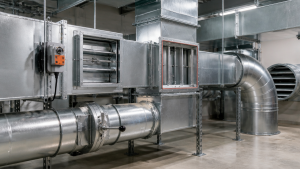
In commercial HVAC systems, every degree of turbulence costs energy. The gentle curve of a 45 degree elbow reduces friction loss, meaning your fans and compressors consume less power to maintain target airflow. Durmahvac recommends 45° fittings for main supply duct runs where consistent static pressure is essential.
Learn more about how duct design affects system efficiency in our guide to HVAC duct fabrication solutions.
5.2 For long runs with gradual direction changes
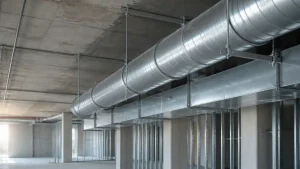
When a duct needs to ease around a structural beam or ceiling joist, a 45 degree elbow avoids the abrupt pressure spike of a 90° fitting. This is particularly relevant in large commercial buildings or industrial facilities where duct runs extend over long distances.
5.3 For pairing to create smoother 90° turns
Two 45 degree elbows placed 6–12 inches apart create a “double 45°” configuration that achieves a 90° direction change with noticeably less turbulence than a single 90° elbow. This technique is standard practice in higher-spec HVAC installations.
6.When Should You Use a 90 Degree Elbow?
6.1 In tight spaces requiring right-angle turns
Under-counter installations, wall cavities, and mechanical rooms often leave no room for a gradual bend. A 90 degree elbow solves this cleanly — one fitting, one turn, no wasted space.
6.2 In gravity-fed or low-pressure systems
Drain lines, condensate pipes, and rainwater downspouts rely on gravity rather than pumps. In these applications, the higher turbulence of a 90° turn is not a concern — the system pressure is low enough that flow resistance is negligible.
For condensate and drainage line planning in HVAC installations, see our rectangular duct machine product page.
6.3 For structural and architectural pipework
In exposed pipework — industrial-style interiors, rooftop mechanical units, or equipment support frames — a 90 degree elbow creates crisp, angular lines that are both visually clean and structurally stable.
7.Common Mistakes to Avoid
7.1 Using a 90° elbow in a high-pressure HVAC supply duct
the sharp turn creates significant static pressure loss, forcing your air handling unit to work harder. In high-velocity systems, this adds up to measurable energy waste over a year.
7.2 Forcing a 45° elbow into a confined space
its wider turn radius requires more linear clearance. Cramming it into a tight cabinet or ceiling void risks kinking the duct or creating an unintended restriction.
7.3 Mixing incompatible materials
a galvanized steel elbow connected to an aluminum duct without a proper coupling creates corrosion points over time. Always match materials or use certified transition fittings.
7.FAQ
Q1: Can two 45 degree elbows replace one 90 degree elbow?
A: Yes — and in pressurized HVAC systems, this “double 45°” configuration is often preferred. It achieves the same direction change with lower turbulence and reduced static pressure loss.
Q2: Which elbow is better for HVAC ductwork?
A: For supply and return air ducts where airflow efficiency matters, 45 degree elbows are generally preferred. For drain pans, condensate lines, or tight-space installations, 90 degree elbows are the practical choice.
Q3: Do 45 degree elbows cost more than 90 degree elbows?
A: Prices are comparable. At Durmahvac, both fitting types are manufactured to the same quality standards, with availability in galvanized steel, stainless steel, and aluminum to suit different HVAC environments.
8.The Durmahvac Recommendation
Choosing between a 45 degree elbow and a 90 degree elbow comes down to two factors: available space and system pressure.
- Need smooth, efficient airflow over a long run? Choose the 45 degree elbow.
- Working in a tight corner or low-pressure drain system? The 90 degree elbow is your answer.
- High-pressure supply duct with limited space? Use a double 45° configuration.
For HVAC systems where energy efficiency and noise reduction are priorities, Durmahvac’s duct elbow fittings are engineered to minimize pressure drop while maintaining structural durability across years of operation.
9.Conclusion
Choosing between a 45 degree elbow and a 90 degree elbow comes down to two things: system pressure and available space. Use a 45° where airflow efficiency matters; use a 90° where space is tight. When both are a concern, a double 45° configuration is the practical answer.
At Durmahvac, we manufacture elbow fittings and duct components built for commercial and industrial demands — consistent quality, every fitting, every order. Have a project in mind? Contact our team — we’ll get back to you promptly.