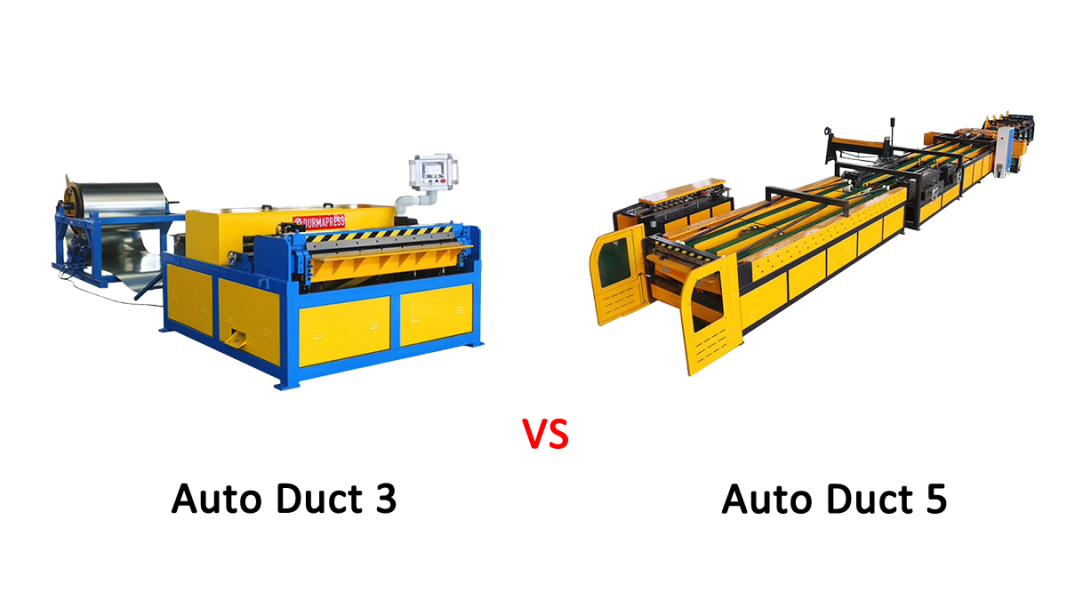
Auto Duct Line 3 and Auto Duct Line 5 are the two most widely used automated production lines for rectangular HVAC duct fabrication. Both handle the core workflow — uncoiling, leveling, punching, and cutting — but differ significantly in automation level, integrated functions, footprint, and cost.
This article breaks down the key differences and helps you decide which line fits your production scale and budget.
1.What Do the Numbers Mean?
The number in the product name reflects the automation and integration level of the line. A higher number means more processes are integrated into a single machine, requiring less manual intervention and separate standalone equipment.
- Auto Duct Line 3 — Entry-level automation. Covers core blanking processes; downstream forming steps (Pittsburgh seaming, TDF flanging) require separate machines.
- Auto Duct Line 5 — High integration. Incorporates Pittsburgh lock forming and TDF flange forming directly into the line, outputting near-complete duct panels in a single pass.
2.Core Function Comparison
| Function | Auto Duct Line 3 | Auto Duct Line 5 |
|---|---|---|
| Uncoiling & Leveling | ✓ | ✓ |
| Beading & Ribbing | ✓ | ✓ |
| Notching & Punching | ✓ | ✓ |
| Shearing to length | ✓ | ✓ |
| Auto Bending & Forming | ✓ | ✓ |
| Pittsburgh Lock Forming | Separate machine needed | ✓ Built-in |
| TDF Flange Forming | Separate machine needed | ✓ Built-in |
| Layout | Linear | U-shaped |
| Production speed | 4–6 m/min | 6–10 m/min |
| Total power | 8–11.5 kW | ~30 kW |
| Approximate footprint | 4100×1950×1300 mm | 16500×5000×1500 mm |
| Relative cost | Lower | Higher |
3. Key Differences Explained
3.1 Integration Level
Auto Duct Line 3 follows a modular approach: the machine itself handles blanking, and you pair it with a lock forming machine and TDF flange forming machine for downstream processes. This keeps the initial investment low but requires more floor space and manual handling between stations.
Auto Duct Line 5 integrates all of these into one continuous line. From raw coil to a panel ready for seam joining — no secondary equipment, no manual transfer between machines.
3.2 Space & Layout
Auto Duct Line 3 uses a straight linear layout and has a compact footprint, making it suitable for workshops with limited space or irregular floor plans.
Auto Duct Line 5 uses a U-shaped layout that folds the production flow back on itself. While total machine length is much longer, the U-shape actually reduces the effective floor area needed compared to a fully linear equivalent, and allows one operator to monitor both ends of the line.
3.3 Labor Requirements
Auto Duct Line 3 typically requires 2–3 operators to manage material handling, bending, and secondary processing steps. Auto Duct Line 5 reduces this to 1–2 operators through higher automation, directly lowering per-unit labor costs at scale.
4.Which One Should You Choose?

Choose Auto Duct Line 3 if:
- You are a startup or small-to-medium shop with a limited budget
- Order volumes are moderate and product types are varied
- You already have or plan to add standalone lock forming and flanging machines
- Factory floor space is limited
Choose Auto Duct Line 5 if:
- You handle large-volume, standardized duct orders regularly
- Reducing labor costs and manual handling is a priority
- You need consistent quality across thousands of meters of ductwork
- You want to minimize the number of standalone machines in your workflow
5.Conculsion
Auto Duct Line 3 and Auto Duct Line 5 serve different stages of HVAC duct manufacturing operations. Line 3 is the practical, cost-controlled entry point into automated production — flexible, compact, and easy to scale with add-on equipment. Line 5 is the integrated solution for manufacturers who need maximum throughput, minimal labor, and consistent output quality at scale.
For most small and medium factories, Line 3 is the right starting point. As order volumes grow and labor costs become a bigger factor, upgrading to Line 5 — or running both in parallel — becomes a logical next step.
Contact us to discuss your production requirements and get a configuration recommendation tailored to your workshop.