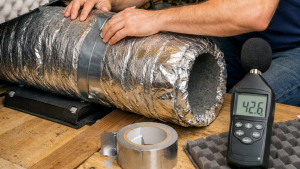

1. Why HVAC Duct Systems Generate Noise?
HVAC duct noise isn’t random — it comes from three distinct mechanisms, and knowing which one you’re dealing with determines the fix.
- Airflow turbulence occurs when air hits sharp bends, sudden cross-section changes, or undersized sections of ductwork. Instead of flowing smoothly, the air tumbles and spins, producing the whooshing, whistling, or rushing sounds that are common in high-velocity systems.
- Mechanical vibration starts at the fan or compressor and travels through rigid metal connections into the ductwork, then into walls and ceilings. The duct itself becomes a resonating surface, amplifying what might otherwise be a minor mechanical hum into an audible drone throughout the building.
- Thermal expansion is the cause of the popping or banging sounds that happen when the system first starts up or shuts down. Sheet metal expands when warm air passes through and contracts when it cools — in a duct that’s tightly fitted or poorly supported, that movement creates noise.
2. Diagnosing the Noise First
Before reaching for insulation tape or ordering silencers, spend two minutes diagnosing. The same symptom can have completely different causes, and treating the wrong one wastes time and money.
| Noise performance | Possible reasons | refer |
|---|---|---|
| Whistling / whooshing (constant during operation) | High air velocity, undersized duct or grille | Airflow Noise |
| Popping / banging (at startup or shutdown) | Thermal expansion of sheet metal | Vibration & Expansion |
| Humming / buzzing (during operation) | Mechanical vibration transmitted through duct walls | Vibration & Expansion |
| Sound carrying room to room | Crosstalk through shared duct runs | Crosstalk |
| Rattling at a specific register | Loose grille, debris in duct, or high static pressure | Maintenance Issues |
3.Reducing Airflow Noise — Velocity and Duct Design
3.1 Control Air Velocity
High air velocity is the most common cause of duct noise in both residential and commercial systems. As a general reference, supply duct velocity above 900 ft/min (4.5 m/s) in residential applications tends to generate audible noise — commercial systems can tolerate slightly higher speeds, but noise increases significantly beyond 1,500 ft/min (7.5 m/s).
The fix isn’t always to slow the fan down. Undersized ductwork forces the same volume of air through a smaller cross-section, which raises velocity even when fan speed is correct. If noise appeared after a renovation that added or relocated duct runs, check whether the existing trunk duct is still appropriately sized for the system load.
3.2 Fix Sharp Bends and Transitions
A 90° hard elbow creates significantly more turbulence than a radius bend. Where ductwork geometry can’t be changed, turning vanes inside the elbow guide airflow around the corner without the air colliding with the outer wall. This is a low-cost retrofit that makes a measurable difference on noisy elbows.
Abrupt cross-section changes — where a large duct suddenly reduces to a smaller one — generate the same problem. A gradual transition (taper ratio of no more than 1:4) keeps airflow attached to the duct wall instead of separating into turbulent eddies.
3.3 Install Duct Attenuators / Silencers
Duct silencers (also called attenuators) are lined sections installed in the duct run to absorb sound energy before it reaches occupied spaces. The most effective placement is immediately downstream of the fan or air handling unit — that’s where mechanical noise enters the duct system.
For HVAC duct systems serving meeting rooms, offices, or bedrooms, silencers on both supply and return branches are worth the investment. Note that silencers add static pressure drop — factor this into fan selection if retrofitting an existing system.
4.Controlling Vibration and Mechanical Noise
4.1 Decouple the Fan from the Ductwork
Rigid connections between the fan unit and the duct run are one of the most common sources of structural noise. A flexible duct connector — typically a short section of heavy fabric or rubber — breaks the vibration path between the fan housing and the metal ductwork. This single change often produces the most noticeable noise reduction of any retrofit measure.
The connection between the equipment and the building structure matters equally. Fan units and air handling equipment sitting directly on concrete floors or steel frames transmit vibration efficiently. Anti-vibration mounts (rubber isolation pads or spring mounts) beneath the equipment interrupt that transmission path.
4.2 Decouple the Fan from the Ductwork
Rigid connections between the fan unit and the duct run are one of the most common sources of structural noise. A flexible duct connector — typically a short section of heavy fabric or rubber — breaks the vibration path between the fan housing and the metal ductwork. This single change often produces the most noticeable noise reduction of any retrofit measure.
The connection between the equipment and the building structure matters equally. Fan units and air handling equipment sitting directly on concrete floors or steel frames transmit vibration efficiently. Anti-vibration mounts (rubber isolation pads or spring mounts) beneath the equipment interrupt that transmission path.
4.3 Support Ductwork Properly
Duct hangers that allow metal-to-metal contact with structural members create a direct vibration bridge. Replacing standard hangers with rubber-lined hangers or adding rubber grommets at contact points costs very little but significantly reduces the vibration conducted into the building fabric.
Flexible ductwork that sags or kinks between supports causes both vibration noise and airflow restriction. The rule of thumb for flexible duct is a maximum sag of 12mm per metre of run — beyond that, support spacing needs to be reduced.
4.4 Address Thermal Expansion Noise
Popping and banging at startup is almost always a thermal expansion issue. The metal is expanding against something — a tight hanger, a wall penetration, or an adjacent duct section. Check every support and penetration along the noisy duct run and ensure there’s clearance for movement. Foam sleeve insulation at wall penetrations prevents the duct from banging against the sleeve opening as it expands.
5.Duct Insulation and Lining — Choosing the Right Approach
Not all insulation addresses noise, and not all noise problems are solved by insulation. The table below separates what each approach actually does:
| Solution | Main Function | Applicable Scenarios | Limitations |
|---|---|---|---|
| Internal Duct Liner | Absorbs airflow noise and echo inside ducts | New ventilation systems, echo issues | Slightly reduces effective duct area |
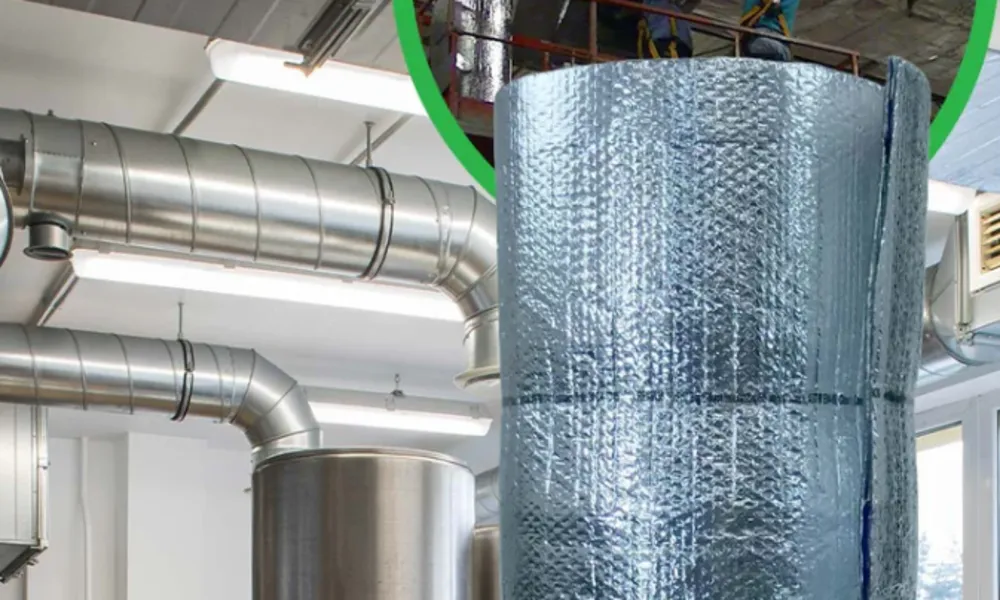
| External Duct Wrap | Blocks vibration from spreading to surrounding structures | Retrofit projects, vibration noise | Does not reduce airflow noise |
| Duct Silencer / Attenuator | Eliminates high-frequency noise from fans and airflow | Fan outlets, branch connections | Increases static pressure, may require fan upgrade |
| Mass Loaded Vinyl (MLV) | Blocks low-frequency noise transmission through duct walls | Low-frequency noise, commercial projects | Higher cost |
For most retrofits, external acoustic wrap combined with flexible connectors at the fan handles the majority of vibration-related complaints. If crosstalk or airflow noise is the primary issue, internal liner or silencers are the right tool — wrapping the outside of the duct won’t help.
When specifying internal liners, always confirm the product is fire-rated and doesn’t shed particles into the airstream. This is non-negotiable for systems handling supply air to occupied spaces.
6.Maintenance Issues That Cause Noise
Many HVAC noise problems come from poor maintenance, not system design. Check these first:
- Dirty air filters — Clogged filters increase pressure and amplify noise. Replace regularly.
- Duct leaks — Gaps cause whistling sounds. Seal with foil tape or mastic.
- Closed dampers — Restricted airflow raises system pressure and noise. Keep dampers open unless needed.
- Debris in ducts — Loose materials can rattle. Inspect ducts if noise appears suddenly.
7.FAQ
Popping sounds usually come from duct expansion and contraction due to temperature changes. Tight supports or contact points restrict movement—adding clearance typically fixes it.
Q2: How do I stop HVAC noise from traveling between rooms?Use duct silencers on branches and internal duct liners. Avoid straight shared duct runs between rooms for a long-term solution.
Q3: What is a duct silencer and where should it be installed?A duct silencer is a sound-absorbing duct section. Install it after the fan/AHU or on branch ducts to reduce noise transfer.
Q4: Does duct insulation reduce noise?External insulation reduces vibration; internal liner reduces airflow noise and crosstalk. Choose based on noise type.
Q5: Can duct size affect HVAC noise levels?Yes. Undersized ducts increase airflow velocity and noise. Enlarging duct size is the permanent fix.
Q6: What causes whistling from air vents?Usually airflow restriction from small grilles, closed dampers, or mismatched vent types. Upgrading the grille often solves it.
8.Conclusion
Most HVAC duct noise problems are solvable once the source is correctly identified. Airflow noise calls for velocity control and better duct geometry; vibration noise requires mechanical decoupling; crosstalk needs acoustic treatment inside the duct. Applying the wrong solution wastes material and leaves the problem unchanged.
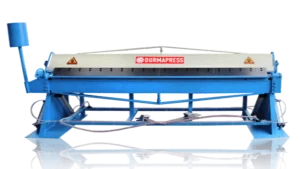
For projects where duct fabrication quality directly affects acoustic performance, the forming precision of HVAC duct forming machines plays a role — poorly formed joints and seams are a common source of both leakage noise and structural weak points. If you’re specifying equipment for a new duct production line, contact us — our team can advise on machine configurations suited to your profile and production volume.