What is HVAC Duct Sizing?
In many HVAC projects, improper duct sizing is one of the hidden reasons behind poor airflow, high energy consumption, and uncomfortable indoor environments.
HVAC duct sizing is the process of determining the correct duct dimensions based on airflow requirements, velocity, and system pressure. When done correctly, it ensures efficient air distribution and stable system performance. When done wrong, it can lead to long-term operational issues that are costly to fix.Understanding the basics of HVAC ductwork types and materials can help you better approach duct sizing.
Why Proper Duct Sizing is Important
Proper duct sizing directly impacts not only airflow but also the overall efficiency and lifespan of an HVAC system.
In real-world applications, undersized ducts often force the system to work harder, increasing energy consumption and noise levels. On the other hand, oversized ducts may reduce efficiency while increasing material and installation costs without delivering proportional benefits.
Finding the right balance between performance, cost, and space is essential in any HVAC project.
Key Factors in HVAC Duct Sizing
Understanding the core variables is the foundation of accurate duct sizing.
1. Airflow (CFM)
Airflow, measured in CFM (Cubic Feet per Minute), defines how much air needs to be delivered to a space.
It is typically determined based on room size, occupancy, and heating or cooling load requirements.
2. Air Velocity
Air velocity (FPM) plays a critical role in both efficiency and comfort.
| Application | Velocity (FPM) |
|---|---|
| Residential | 600–900 |
| Commercial | 800–1200 |
| Industrial | 1000–1500 |
Higher velocity reduces duct size but increases noise and pressure loss.
Lower velocity improves comfort but requires more space.
3. Duct Area
The duct’s cross-sectional area determines how much air can flow through the system.
4. Static Pressure
Static pressure reflects the resistance within the duct system.
In practice, systems with high resistance require either larger ducts or more powerful fans—both of which increase cost.
HVAC Duct Sizing Formulas
Accurate sizing depends on applying the right formulas.
Airflow Formula
Area Calculation
Rectangular duct:
Round duct:
Equivalent Diameter
This is especially useful when comparing rectangular and round ducts in real projects.

Step-by-Step HVAC Duct Sizing Calculation
Step 1: Determine Airflow Requirement
Start with the required airflow.
Example:1000 CFM
Step 2: Select Air Velocity
Choosing the right air velocity is one of the most important decisions.
Higher velocity:
- Smaller ducts
- Lower upfront cost
- More noise + higher pressure loss
Lower velocity:
- Better airflow quality
- Less noise
- Larger ducts + higher installation cost
In real projects, engineers balance performance, noise, and space constraints.
Step 3: Calculate Required Area
Example:
Step 4: Determine Duct Size
Rectangular:12″ × 12″
Round:≈ 13.5 inches diameter
Step 5: Check Pressure Loss
In real installations, pressure loss is often underestimated—especially in systems with long duct runs or multiple bends.
If pressure is too high:
- Increase duct size
- Optimize layout
Many airflow problems are related to leakage—see our HVAC duct leakage guide.
HVAC Duct Sizing Chart (Quick Reference)
| CFM | Velocity | Round Duct |
|---|---|---|
| 500 | 800 | 10″ |
| 800 | 900 | 12″ |
| 1000 | 1000 | 14″ |
| 1500 | 1200 | 16″ |
Useful for quick estimation during early design stages.
Example: Real HVAC Duct Sizing Calculation
Let’s look at a practical case:
Given:
- Airflow: 1200 CFM
- Velocity: 1000 FPM
Step 1: Calculate Area
Step 2: Select Duct Size
Rectangular14″ × 12″
Round≈ 15″
Step 3: Engineering Adjustment
In real-world projects, the final decision may depend on:
- Ceiling space limitations
- Installation complexity
- Cost considerations
For example:
Rectangular ducts are often used in tight spaces—even though round ducts perform better aerodynamically.
Common Duct Sizing Mistakes
Undersized Ducts
- High velocity
- Excessive noise
- Increased system load
Leads to higher energy costs and shorter equipment lifespan.
Oversized Ducts
- Higher material cost
- Inefficient airflow
Ignoring Pressure Loss
- System fails to deliver required airflow
Poor Layout Design
- Too many bends increase resistance
How to Optimize HVAC Duct Sizing
1. Reduce Pressure Loss
Lower velocity improves efficiency.
2. Optimize Layout
- Reduce bends
- Use smooth transitions
3. Balance Airflow
Ensure even distribution across all zones.
How Fabrication Affects Duct Sizing Accuracy
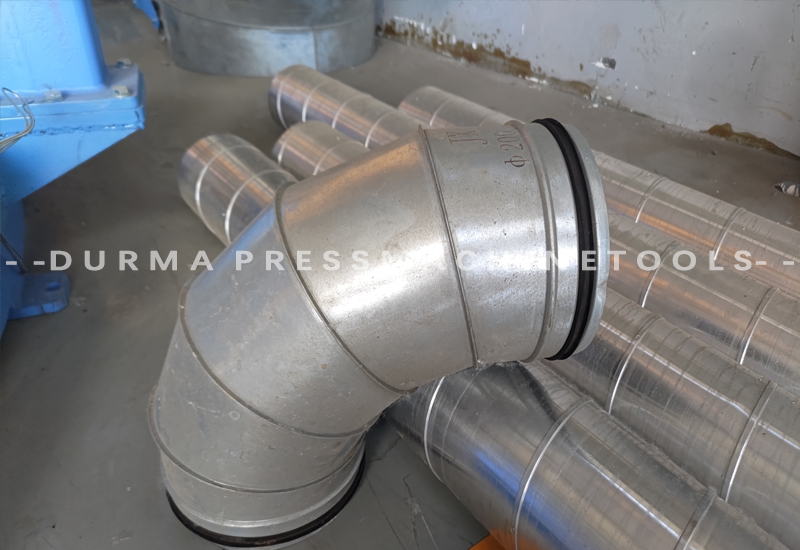
In theory, duct sizing is based on precise calculations. In reality, performance depends heavily on fabrication quality.
Even small deviations in cutting or bending can lead to:
- Air leakage
- Increased resistance
- Installation misalignment
This is why accurate manufacturing is critical.
Role of Equipment
- Press Brake → precise bending
- Lockformer → tight seams
- Auto Duct Line → consistent production
High-precision equipment ensures that design calculations are actually achieved in practice.Choosing the right equipment is essential—explore our guide to HVAC duct making machines
Conclusion
HVAC duct sizing is not just a calculation—it is a practical engineering process that requires balancing airflow performance, cost, and real-world constraints.
A well-designed system must also be supported by precise fabrication and proper installation. Without these, even the most accurate calculations can fail.
For manufacturers and contractors, combining engineering expertise with reliable production equipment is the key to consistent, high-performance HVAC systems.
FAQ
1. How do you calculate duct size?
Divide airflow (CFM) by velocity to get area, then convert to dimensions.
2. What is the formula for duct sizing?
CFM = Velocity × Area
3. What happens if ducts are too small?
Higher pressure, noise, and energy consumption.
4. What is the ideal air velocity?
Typically 600–1500 FPM depending on application.
5. How to reduce pressure loss?
Lower velocity and optimize layout.