1.Introduction
Defects in HVAC duct fabrication rarely announce themselves. A misaligned seam, an under-sealed joint, or a warped duct section can go undetected through installation — only showing up later as reduced airflow, higher energy bills, or system failures that are expensive to diagnose and repair.
For fabricators and contractors, catching these defects early is far cheaper than correcting them after the system is commissioned. This guide covers the eight most common defects found in HVAC duct fabrication, what causes each one, and the most effective way to fix or prevent it.

2. Leaking Seams and Joints
Leaking seams are the most prevalent defect in duct fabrication and account for a significant share of HVAC system energy losses. They occur when longitudinal seams or transverse joints are not fully closed, leaving gaps that allow conditioned air to escape before it reaches the intended space.
The root causes are usually insufficient sealant application, incorrect seam folding during fabrication, or joints that were not properly compressed before the sealant cured. In high-velocity systems, even a small gap can produce measurable pressure loss.
How to fix it: Apply mastic sealant or UL 181-rated foil tape over all seams and joints after assembly. For pressure-sensitive applications, conduct a duct leakage test (blower door or duct pressurization) before installation to quantify leakage rates and identify specific failure points. Do not rely on standard duct tape — it degrades over time and is not rated for sustained HVAC use.
3. Warped or Deformed Duct Panels
Warping occurs when sheet metal panels are subjected to uneven stress during cutting, bending, or handling. The result is duct sections that do not sit flat, creating gaps at joints and making assembly more difficult. In rectangular ducts, panel warping is especially common on wider spans where the sheet lacks sufficient stiffness.
Poor material storage is a frequent contributor — sheets stored on uneven surfaces or stacked without protective padding develop permanent deformation before fabrication even begins.
How to fix it: For minor warping, cross-breaking (pressing diagonal ridges into the panel surface) adds stiffness and can flatten slight deformations. For severe warping, the panel should be rejected and re-cut. Prevent the problem upstream by storing sheet metal on flat, padded racks and handling large panels with appropriate lifting equipment to avoid flexing during transport. Consistent duct fabrication machine settings for bending pressure also reduce stress concentration during forming.
4.Incorrect Dimensions and Fit-Up Errors
Ducts that are cut or formed even a few millimeters outside of specification cause fit-up problems during installation — joints that won’t seat properly, connections requiring forced alignment, and assembled sections that introduce unintended bends in the duct run. In complex systems with multiple transitions and offsets, dimensional errors compound across the run.
Manual measurement with tape measures or rulers introduces human variability. The problem worsens when different fabricators interpret the same drawing differently.
How to fix it: Implement laser measuring tools and digital layout software at the measurement stage to reduce human error. Establish a protocol where measurements are verified by a second person before cutting begins. For repeat production runs, use pre-set stops and guides on cutting and bending equipment to ensure consistent dimensions across batches.
5.Poor Weld Quality and Incomplete Seam Closure
Welded seams that are porous, cracked, or incompletely fused create both structural weakness and air leakage paths. This is particularly critical in industrial HVAC applications where ducts handle high-velocity airflow or operate under sustained pressure differentials.
Weld quality issues stem from skill variation between welders, worn or improperly calibrated equipment, and rushing through seam welding under production pressure. Environmental factors — humidity, surface contamination, and temperature — also affect weld integrity.
How to fix it: Standardize welding parameters (amperage, travel speed, wire feed rate) for each material thickness used in your shop. Implement mandatory weld inspections — visual inspection as a minimum, with non-destructive testing for critical applications. For consistent, high-volume seam production, consider transitioning to automated seam welding or plasma cutting machines with integrated seam finishing rather than relying solely on manual processes.

6.Inadequate Insulation Application
Insulation defects in duct fabrication take two forms: missing coverage and improper installation. Gaps in insulation — even small ones — create thermal bridges where heat transfers through the duct wall, reducing system efficiency. Compressed insulation loses its R-value, while insulation applied to contaminated or wet surfaces fails to bond and eventually separates.
In ducts running through unconditioned spaces such as attics or mechanical rooms, insulation defects directly translate into measurable energy losses.
How to fix it: Select insulation with the correct R-value for the application and climate. Apply insulation in continuous runs without gaps, overlapping seams by at least 50mm. Never compress fiberglass insulation to fit a smaller space — compression destroys its thermal performance. Inspect the duct surface for contamination before application and ensure surfaces are dry. For finished installations, use an infrared camera to identify cold spots that indicate insulation gaps or voids.
7. Airflow-Restricting Geometry Defects
Geometry defects — sharp internal bends, abrupt cross-section changes, and poorly formed transitions — restrict airflow and increase static pressure throughout the duct system. These defects often result from shortcuts taken during fabrication: cutting corners on transition geometry, forming bends at tighter radii than specified, or assembling offset sections without proper angle calculation.
The performance impact accumulates across a system. A duct run with several geometry defects can require the air handling unit to work significantly harder to maintain design airflow, increasing both energy consumption and wear.
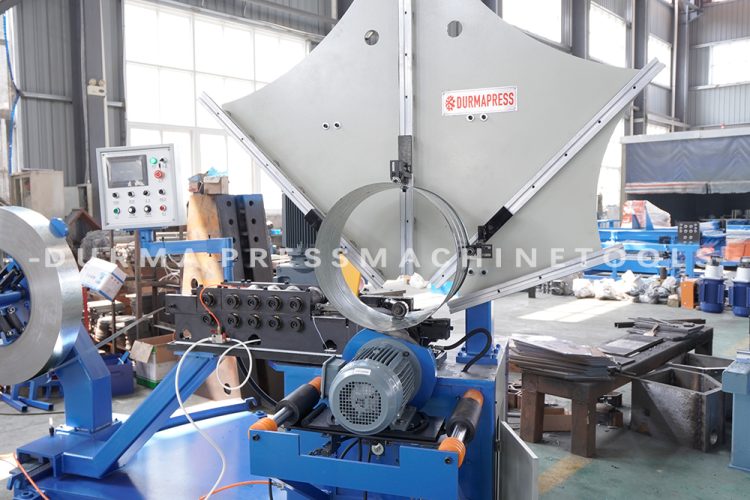
How to fix it: Follow SMACNA (Sheet Metal and Air Conditioning Contractors’ National Association) guidelines for minimum bend radii, transition angles, and fitting geometry. Use spiral duct machines or rectangular duct machines with CNC controls for consistent, specification-compliant geometry across high-volume production.For bespoke transitions, use CAD to model the geometry before fabrication begins, verifying angles and cross-sections against design specifications.
8. Surface Contamination and Corrosion
Corrosion defects begin before fabrication even starts. Sheet metal stored in humid environments, or handled without gloves, accumulates surface oxidation and contamination that compromises both coating adhesion and long-term structural integrity. Once ducts are installed, surface defects accelerate corrosion, especially in humid climates or applications involving moisture-laden airstreams.
Galvanized steel — the standard material for most HVAC ductwork — loses its corrosion resistance at cut edges and weld zones where the zinc coating is damaged during fabrication.
How to fix it: Store sheet metal in climate-controlled conditions on padded racks, away from moisture sources. Inspect material surfaces before cutting for rust spots or contamination. After cutting and welding, apply cold galvanizing compound or zinc-rich primer to cut edges and weld areas to restore corrosion protection. For applications with sustained humidity or corrosive airstreams, specify stainless steel or aluminum rather than galvanized steel from the outset.
9. Noise-Generating Fabrication Defects
Noise complaints in HVAC systems often trace back to fabrication defects rather than equipment problems. Loose panel sections that vibrate under airflow, sharp internal edges that generate turbulence noise, and improperly tensioned seams that flex under pressure cycling all contribute to system noise that is difficult to diagnose and expensive to correct after installation.
How to fix it: Cross-break all flat panels during fabrication to add stiffness and eliminate panel flutter. Ensure all seams are fully closed and fastened before sealant application — a seam that relies on sealant alone for closure will flex under pressure. Deburr all cut edges to eliminate turbulence points. After assembly, physically flex each duct section to check for loose areas before sealing. Use flexible duct connectors at equipment connections to isolate mechanical vibration from the duct run.
10. Preventing Defects Starts at the Fabrication Stage
Most of the defects covered in this guide share a common thread: they are significantly easier and cheaper to prevent during fabrication than to correct after installation. The key levers are equipment consistency, material handling discipline, and systematic quality checks at each stage of production.
For fabricators handling high volumes or complex duct geometries, investing in precision machinery — including CNC-controlled duct fabrication equipment — reduces the variability that underlies most dimensional and geometry defects.Pairing equipment investment with structured operator training and documented inspection protocols creates a fabrication process where defects are caught before they become installed problems.
11. Conclusion
Leaking seams, warped panels, poor welds, insulation gaps — each defect type has a defined cause and a practical fix. Addressing them systematically, rather than waiting for system performance complaints, protects both the quality of your work and the efficiency of the systems your ducts serve.
If you’re evaluating fabrication equipment that reduces defect rates at the source, contact our team to discuss the right machinery for your production requirements.