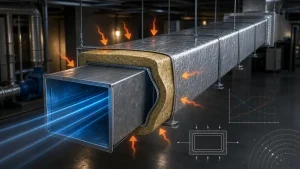
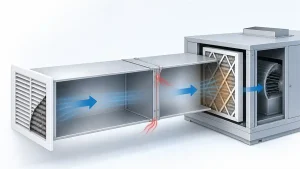
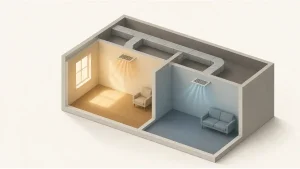
HVAC dampers are airflow control components installed inside ductwork. They regulate, balance, redirect, stop, or isolate air movement in heating, ventilation, air conditioning, exhaust, and industrial air systems.
For users searching for types of HVAC dampers, the key question is simple: which damper type does what, and where should it be used? Some dampers control normal airflow, some prevent reverse airflow, some protect fire-rated barriers, and others are used for industrial isolation or pressure control.
This guide explains the main HVAC damper types, their functions, typical applications, and the key factors to consider when choosing the right damper for a duct system.
1.What Is an HVAC Damper?
An HVAC damper is a movable plate, blade, disc, or valve installed inside a duct or air handling system to control airflow.
Depending on the design, a damper can:
- Open fully to allow airflow
- Partially close to reduce airflow
- Modulate airflow during system operation
- Balance air between duct branches
- Prevent reverse airflow
- Close during fire or smoke events
- Isolate duct sections for maintenance or safety
In simple terms, a damper works like a valve for air. Instead of controlling liquid in a pipe, it controls conditioned air, exhaust air, return air, outside air, or process air inside ductwork.
HVAC dampers are used in residential, commercial, and industrial systems, but their importance is especially clear in larger buildings and factories where airflow, pressure, safety, and system efficiency must be controlled accurately.
2.How Do HVAC Dampers Work?
HVAC dampers work by changing the position of a blade or group of blades inside the duct. When the blade is open, air passes through. When it closes, airflow is reduced or blocked.
Dampers can be classified by actuation method as manual or motorized.
2.1 Manual Dampers
Manual dampers are adjusted by hand using a lever, handle, or locking quadrant mounted outside the duct.
In many duct systems:
- A handle parallel to the duct means the damper is open.
- A handle perpendicular to the duct means the damper is closed.
- A partial position reduces airflow.
Manual dampers are commonly used for duct balancing, seasonal adjustment, and simple airflow control where continuous automation is not required.
2.2 Motorized Dampers
Motorized dampers use an actuator to open, close, or modulate the damper blade automatically.
They may connect to:
- Thermostats
- Zone control panels
- Building automation systems
- Pressure sensors
- Occupancy sensors
- Smoke control systems
- Fire alarm systems
A motorized damper is not always a separate damper category by function. For example, a control damper, smoke damper, or zone damper can also be motorized. This is why it is more accurate to treat “motorized” as an actuation method rather than a completely separate damper function.
3. Types of HVAC Dampers
HVAC dampers can be classified in several ways:
- By function: control, balancing, backdraft, fire, smoke, pressure relief
- By actuation: manual or motorized
- By design or application: butterfly, louver, inlet vane, guillotine, isolation
The table below gives a quick comparison of common HVAC damper types and their typical uses.
| Damper Type | Primary Function | Typical Application |
|---|---|---|
| Control Damper | Regulates airflow volume | HVAC systems, air handling units, ventilation ducts |
| Balancing Damper | Adjusts branch airflow | Duct balancing and commissioning |
| Backdraft Damper | Prevents reverse airflow | Exhaust systems and ventilation outlets |
| Fire Damper | Limits fire spread | Fire-rated walls, floors, and barriers |
| Smoke Damper | Controls smoke movement | Smoke control and life safety systems |
| Combination Fire/Smoke Damper | Controls both fire and smoke | Commercial buildings and public facilities |
| Pressure Relief Damper | Relieves excess pressure | Exhaust and ventilation systems |
| Butterfly Damper | Controls or shuts off airflow | Round ducts and industrial systems |
| Louver Damper | Controls airflow with multiple blades | General HVAC and ventilation systems |
| Inlet Vane Damper | Controls fan inlet airflow | Fans, blowers, and industrial ventilation |
| Guillotine / Isolation Damper | Isolates duct sections | Industrial ductwork and maintenance shutdowns |
3.1 Control Dampers
Control dampers regulate the volume of air moving through a duct or air handling system. They are one of the most common types of HVAC dampers.
They are used in:
- Supply air systems
- Return air systems
- Mixing boxes
- Air handling units
- Ventilation systems
- Multi-zone HVAC systems
- Industrial airflow control systems
Control dampers may be manual or motorized. In commercial HVAC systems, they are often connected to actuators and building automation systems so they can respond to temperature, pressure, or ventilation demand.
Two common blade arrangements are:
- Parallel blade dampers: blades move in the same direction.
- Opposed blade dampers: adjacent blades move in opposite directions.
Parallel blade dampers are often used for open/close control or directional airflow. Opposed blade dampers are commonly used when smoother airflow modulation is required.
3.2 Balancing Dampers
Balancing dampers are used to adjust airflow between different duct branches. Their purpose is to help each room, zone, or duct run receive the correct air volume.
During testing and balancing, a technician measures airflow and adjusts the balancing damper until the system reaches the required air distribution. Once the correct airflow is achieved, the damper position is usually locked.
Balancing dampers help solve problems such as:
- Uneven heating or cooling
- One room receiving too much air
- One room receiving too little air
- Pressure imbalance
- Airflow noise
- Poor system commissioning results
A balancing damper is different from a control damper. A control damper may adjust during normal operation, while a balancing damper is usually set during commissioning and left in a fixed position.
3.3 Backdraft Dampers
Backdraft dampers allow air to flow in one direction and prevent reverse airflow.
They are commonly used in:
- Exhaust fans
- Ventilation outlets
- Kitchen exhaust systems
- Industrial exhaust ducts
- Outdoor air discharge points
- Ducts where contaminated air must not return
When airflow moves in the correct direction, the damper opens. When airflow stops or reverses, the blades close.
Backdraft dampers help prevent:
- Outdoor air from entering the system
- Exhaust air from returning into the duct
- Odors or fumes from flowing backward
- Fan backspin
- Pressure-related airflow problems
Some backdraft dampers include counterweights or counterbalances to control opening pressure more accurately.
3.4 Fire Dampers
Fire dampers are life safety dampers designed to stop flames from spreading through ductwork.
They are installed where ducts pass through:
- Fire-rated walls
- Fire-rated floors
- Fire barriers
- Partitions
- Shafts
Under normal conditions, a fire damper stays open so air can pass through. During a fire, heat triggers the damper to close. This helps maintain the fire rating of the wall or floor and prevents flames from traveling through the duct system.
Fire dampers are commonly used in:
- Commercial buildings
- Hospitals
- Schools
- Malls
- High-rise buildings
- Industrial facilities
- Public buildings
For commercial projects, fire dampers should be selected according to local building codes, project specifications, and required certifications. UL 555 is commonly associated with fire damper testing and certification.
3.5 Smoke Dampers
Smoke dampers are designed to control smoke movement through HVAC ductwork.
Unlike fire dampers, which mainly respond to heat, smoke dampers are usually connected to smoke detectors, fire alarm systems, or smoke control systems. They may close or modulate depending on the building’s smoke control strategy.
Smoke dampers are important in:
- Hospitals
- High-rise buildings
- Airports
- Schools
- Malls
- Large commercial buildings
- Public facilities
Their purpose is to limit smoke spread, support smoke control zones, and help keep evacuation routes safer during an emergency. UL 555S is commonly associated with smoke damper testing and certification.
3.6 Combination Fire/Smoke Dampers
Combination fire/smoke dampers are designed to control both flame spread and smoke movement.
They are used where a duct passes through a rated barrier and the system also requires smoke control. Instead of using separate fire and smoke dampers, a properly specified combination damper can perform both functions.
Common applications include:
- Hospitals
- Schools
- Malls
- Commercial buildings
- Public facilities
- High-occupancy buildings
- Smoke control zones
When selecting a combination fire/smoke damper, buyers should check:
- Fire rating
- Smoke leakage rating
- Actuator type
- Installation requirements
- Control system compatibility
- Applicable codes and certifications
3.7 Pressure Relief Dampers
Pressure relief dampers open when system pressure exceeds a set level. Their purpose is to prevent over-pressurization in ductwork or ventilation systems.
They are used in:
- Exhaust systems
- Industrial ventilation systems
- Pressure-sensitive duct systems
- Fan discharge systems
- Process air systems
A pressure relief damper is different from a backdraft damper. A backdraft damper prevents reverse airflow, while a pressure relief damper responds to pressure buildup.
Some pressure relief dampers have adjustable opening pressure, allowing engineers to set the response based on the system design.
3.8 Butterfly Dampers
Butterfly dampers use a rotating disc or single blade to control airflow. They are often used in round ducts, industrial systems, and process ventilation.
Butterfly dampers can be used for:
- Flow control
- Shutoff
- Isolation
- Low-leakage applications
- Exhaust systems
- Scrubbers
- Heaters
- Industrial air movement systems
Their advantages include compact structure, simple operation, and relatively low pressure drop.
In industrial applications, butterfly dampers may be designed for high temperature, high pressure, corrosive air, or abrasive airflow. They are practical for many round duct systems, although they may not always be the best choice for highly precise airflow modulation.
3.9 Louver Dampers
Louver dampers use multiple blades to regulate or block airflow. They are widely used in HVAC and ventilation systems.
They may be used for:
- Airflow regulation
- Ventilation control
- Air blocking
- Outdoor air intake
- Exhaust applications
- General duct airflow control
Depending on design, louver dampers may use parallel or opposed blade movement. Some louver dampers overlap with control dampers in function, so the exact performance depends on blade design, frame construction, leakage rating, actuator selection, and application conditions.
3.10 Inlet Vane Dampers
Inlet vane dampers are installed at the inlet side of fans or blowers. They control airflow before it enters the fan.
Instead of simply blocking air downstream, inlet vane dampers change the way air enters the fan. By adjusting vane angle, they can pre-spin the air entering the impeller, helping control flow and pressure.
They are used in:
- Fan inlet systems
- Blowers
- Industrial ventilation systems
- Flue gas systems
- Oven recirculation systems
- Process air systems
Inlet vane dampers can help reduce fan load and improve efficiency in certain applications. They may be considered alongside other control methods, such as variable frequency drives, depending on the system design.
3.11 Guillotine / Isolation Dampers
Guillotine dampers and isolation dampers are used when airflow must be completely shut off or a duct section must be isolated.
A guillotine damper uses a sliding blade that moves into the duct opening. This creates a strong shutoff barrier and allows maintenance teams to isolate equipment or duct sections safely.
Common applications include:
- Scrubber inlet and outlet isolation
- Stack isolation
- Flue gas systems
- Industrial exhaust systems
- High-pressure ductwork
- High-temperature systems
- Maintenance shutdowns
Where leakage must be minimized, bubble-tight or specially sealed isolation dampers may be used.
Important selection factors include:
- Leakage class
- Seal design
- Pressure rating
- Temperature rating
- Blade material
- Corrosion resistance
- Maintenance access
4. Where Are HVAC Dampers Used?
HVAC dampers are used in different duct locations depending on their function.
| Location | Typical Damper Type | Purpose |
|---|---|---|
| Branch ducts | Balancing damper | Adjust airflow to rooms or zones |
| Supply ducts | Control damper | Regulate conditioned air delivery |
| Return ducts | Control or balancing damper | Support return airflow and pressure balance |
| Exhaust ducts | Backdraft damper | Prevent reverse airflow |
| Fire-rated barriers | Fire or fire/smoke damper | Maintain fire-rated separation |
| Smoke control zones | Smoke damper | Limit smoke movement |
| Fan inlet | Inlet vane damper | Control fan airflow and pressure |
| Industrial ductwork | Butterfly, guillotine, isolation damper | Control or isolate process airflow |
| Pressure-sensitive systems | Pressure relief damper | Relieve excess pressure |
Proper placement is important. A damper installed in the wrong location may cause airflow loss, pressure imbalance, noise, excessive leakage, or poor system performance.
For commercial and industrial projects, damper location should be based on duct design, airflow calculations, pressure requirements, and maintenance access.
5. How to Choose the Right HVAC Damper
Choosing the right damper starts with the application. A damper used for fire safety is not selected the same way as a damper used for air balancing, exhaust control, or industrial isolation.
Before selecting a damper, define the main function:
- Airflow control
- Air balancing
- Reverse-flow prevention
- Fire protection
- Smoke control
- Pressure relief
- Fan inlet control
- Duct isolation
- Industrial process airflow control
Then evaluate the technical requirements.
1. Choose by Application
| Application | Recommended Damper Type |
|---|---|
| HVAC zoning | Motorized control damper |
| Air balancing | Balancing damper |
| Exhaust outlet | Backdraft damper |
| Fire-rated wall or floor | Fire damper |
| Smoke control system | Smoke damper or combination damper |
| Fan inlet control | Inlet vane damper |
| Round duct flow control | Butterfly damper |
| Maintenance isolation | Guillotine or isolation damper |
| Industrial exhaust | Heavy-duty control, butterfly, or isolation damper |
| Pressure control | Pressure relief damper |
A clear application match prevents overbuying, underspecifying, and long-term performance problems.
2. Choose by Performance Requirements
For commercial and industrial systems, buyers should evaluate:
- Duct size and shape
- Airflow volume
- Static pressure
- Pressure drop
- Leakage class
- Blade design
- Seal type
- Actuator torque
- Control signal compatibility
- Temperature rating
- Corrosion resistance
- Noise and vibration
- Maintenance access
- Certification requirements
For example, a basic manual damper may be acceptable for branch duct balancing, but it may fail in a high-temperature industrial exhaust system. A fire damper may match the duct size but still be unsuitable if it lacks the certification required by the project specification.
6. HVAC Damper Standards and Compliance
For commercial and industrial HVAC systems, standards and test data should be checked before selecting a damper.
Important factors include:
- UL 555 for fire dampers
- UL 555S for smoke dampers
- Leakage class ratings
- Pressure drop data
- Fire rating requirements
- Smoke control requirements
- Temperature rating
- Corrosion resistance
- Actuator listing and compatibility
- Local building code requirements
Certified products help reduce inspection risk and support project approval. This is especially important for fire dampers, smoke dampers, and combination fire/smoke dampers.
For industrial systems, buyers should also confirm whether the damper can handle high temperature, abrasive particles, corrosive gases, heavy-duty cycles, or high static pressure.
7. HVAC Dampers vs Louvers vs Diffusers
Dampers, louvers, diffusers, grilles, and registers are related air distribution components, but they are not the same.
| Component | Main Function | Typical Location |
|---|---|---|
| Damper | Controls or stops airflow | Inside ductwork |
| Louver | Allows intake or exhaust while blocking rain or debris | Exterior wall or opening |
| Diffuser | Distributes conditioned air into a room | Ceiling or room outlet |
| Grille | Covers an air opening | Wall, ceiling, or return opening |
| Register | Directs room airflow with adjustable blades | Wall, floor, or ceiling |
A damper controls airflow inside the duct system. A diffuser or register affects how air enters a room. A louver is often used for outside air intake or exhaust openings.
In many HVAC projects, these components work together. A duct system may use dampers for balancing, diffusers for air distribution, and louvers for outside air intake.
8.Common HVAC Damper Problems
Damper problems often appear as airflow, comfort, pressure, or safety issues.
Common problems include:
- Uneven heating or cooling
- Low airflow in specific zones
- Excessive airflow noise
- Damper stuck open
- Damper stuck closed
- Failed actuator
- Loose blade linkage
- Incorrect damper size
- Poor damper placement
- Excessive leakage
- Backdraft damper not closing
- Fire or smoke damper not properly inspected
In many cases, the damper itself is not the only cause. Problems may also come from poor duct design, incorrect sizing, lack of balancing, wrong actuator selection, missing maintenance, or improper installation.
For commercial and industrial systems, damper inspection should include blade movement, linkage condition, actuator operation, seals, leakage points, and control response.
9.FAQ
Q1:What are the different types of HVAC dampers?
Common types of HVAC dampers include control dampers, balancing dampers, backdraft dampers, fire dampers, smoke dampers, combination fire/smoke dampers, pressure relief dampers, butterfly dampers, louver dampers, inlet vane dampers, and guillotine or isolation dampers.
Q2:What type of damper is used in an HVAC system?
An HVAC system may use several damper types depending on the function. Control dampers regulate airflow, balancing dampers adjust branch airflow, backdraft dampers prevent reverse airflow, and fire or smoke dampers support life safety requirements.
Q3:What is the difference between a control damper and a balancing damper?
A control damper adjusts airflow during system operation and may be manual or motorized. A balancing damper is usually adjusted during commissioning to set airflow in a duct branch and then locked in position.
Q4:What is the difference between a fire damper and a smoke damper?
A fire damper closes when high heat is detected to help stop flame spread through ductwork. A smoke damper is controlled by smoke detection or a smoke control system to limit smoke movement. Combination fire/smoke dampers handle both functions.
Q5:How do I choose the right HVAC damper?
Start with the damper’s purpose: airflow control, balancing, backdraft prevention, fire safety, smoke control, pressure relief, or isolation. Then check duct size, airflow volume, static pressure, leakage class, temperature rating, actuator type, material, and certification requirements.
10.Conclusion
HVAC dampers are essential components for controlling airflow, balancing duct systems, improving ventilation performance, and supporting building safety. Different damper types serve different purposes, so they should not be selected only by name or price.
For basic airflow control, a control damper may be suitable. For duct balancing, a balancing damper is more appropriate. For exhaust systems, a backdraft damper helps prevent reverse airflow. For life safety applications, fire dampers, smoke dampers, or combination fire/smoke dampers may be required. For industrial ventilation, butterfly, inlet vane, pressure relief, guillotine, or isolation dampers may be needed depending on pressure, temperature, leakage, and maintenance requirements.
The best HVAC damper is the one that matches the system’s airflow function, duct design, safety requirements, operating environment, and long-term maintenance needs. For commercial and industrial projects, always review damper performance data, certification documents, actuator compatibility, and installation requirements before making a final selection.