
Three pressure terms appear constantly in duct calculations, fan datasheets, and commissioning reports — and they are mixed up just as constantly. A fan quoted at “800 Pa” means something different depending on whether that figure is static or total pressure, and a field reading labeled simply “pressure” is close to useless.
The short answer: static pressure is the component associated with overcoming system resistance, dynamic pressure is the kinetic energy of the moving air, and total pressure is the sum of the two. In HVAC work, dynamic pressure is usually called velocity pressure (VP), and the two terms mean the same thing throughout this guide.
What follows is how each value behaves inside a real duct system, how each one is measured, and which one you should be using when you size ductwork, select a fan, or chase down missing airflow.
Static vs Dynamic vs Total Pressure: What’s the Difference?
Air moving through a duct carries pressure in two forms at the same time. Separating them is what makes the terminology useful.
- Static pressure (Ps) acts on the surfaces around the airstream and pushes outward against the duct wall. It exists whether the air is moving or standing still, and it is the component tied to the system’s resistance — filters, coils, bends, dampers, and terminals.
- Velocity pressure (Pv), also called dynamic pressure, exists only because the air is moving. It represents kinetic energy per unit volume.
- Total pressure (Pt) is the sum of the two, and it is the complete expression of the air’s pressure energy at that point.
Total pressure = static pressure + velocity pressure
This relationship is the standard definition used in duct design practice.
| Property | Static pressure | Velocity (dynamic) pressure | Total pressure |
|---|---|---|---|
| Physical meaning | Pressure component acting on surfaces; associated with system resistance | Kinetic energy per unit volume of moving air | Static plus velocity pressure |
| Formula | Depends on system conditions; in ducts, normally read relative to atmospheric pressure | Pv = ½ρv² | Pt = Ps + Pv |
| Depends on velocity | No direct dependence | Yes, proportional to v² | Yes, through the velocity component |
| How it is obtained | Flush static tap or static probe | Derived from total minus static | Impact (total pressure) probe facing upstream |
| Sign in duct systems | Positive or negative relative to atmosphere | Positive whenever flow exists | Positive or negative, depending on the static component |
| Main practical use | Duct and component pressure loss | Velocity traverses and airflow measurement | Fan energy balance and performance rating |
Note the sign behaviour, because it causes confusion on site. Static pressure reads negative upstream of a fan — in return and exhaust ducts, or at a fan inlet — while velocity pressure stays positive whenever air is moving, since velocity is squared.
What Is Static Pressure?
Static pressure is the pressure the air exerts on the surfaces around it, independent of the direction it happens to be travelling. In a duct, it is the component pressing outward on the sheet metal — the same way air pushes on the inside of a balloon.
In air systems, static pressure is the practical currency of resistance. Nearly every published component loss is expressed as a static pressure loss: duct friction, elbows, transitions, branch takeoffs, volume and fire dampers, coils, filters, heat recovery devices, silencers, louvers, grilles, and terminal units.
Static pressure is also a relative figure. Duct pressure is normally reported against ambient atmospheric pressure rather than absolute vacuum, which is why a supply duct downstream of a fan reads positive while a return duct upstream of it reads negative.
The number matters because it decides whether a system can deliver its design airflow at all:
- Too much static pressure cuts airflow, drives up fan power, raises noise, and keeps equipment running longer than intended.
- Too little available static pressure starves remote branches and terminal devices, which makes balancing difficult or impossible.
- External static pressure is the figure normally used when specifying air handling units, since it defines what remains for the duct system outside the unit.
Common causes of unexpectedly high duct static pressure are unglamorous: undersized ductwork, poor installation workmanship, the wrong filter selection, clogged filters left in service, and crushed or kinked flexible duct.
What Is Dynamic Pressure or Velocity Pressure?
Velocity pressure is the kinetic energy of the moving airstream expressed in pressure units. It depends on air density and the square of velocity:
Pv = ½ × ρ × v²
Where ρ is air density and v is velocity. At standard air conditions, density is commonly taken as roughly 1.2 kg/m³, which gives a useful shortcut for quick checks:
Pv ≈ 0.6 × V² (Pv in Pa, V in m/s)
At 6 m/s that works out to about 22 Pa; at 8 m/s, roughly 38 Pa. Those numbers look small beside a few hundred pascals of system resistance, which is exactly why velocity pressure gets ignored — until velocities climb.
The squared term matters more than most designers expect. Double the air speed and velocity pressure quadruples. That single relationship explains several recurring problems.
Shrinking a duct to fit a tight ceiling void does not reduce the air you need to move. It raises velocity, and with it friction loss, velocity pressure, breakout noise, and fan power. The first-cost saving on sheet metal is repaid in electricity for the life of the building, which is why duct sizing method decisions deserve more attention than they usually get.
High velocity also changes how fan data must be read. At a fan discharge running near 10 m/s, outlet velocity pressure is on the order of 60 Pa — enough to matter when comparing a calculated system resistance against a manufacturer’s curve.
What Is Total Pressure?
Total pressure, sometimes called stagnation pressure, is the complete pressure energy of the airstream at a given point: static plus velocity. It is the physically correct quantity for an energy balance, because a fan adds total pressure to the air. How that energy then splits between static and velocity form depends on the duct geometry downstream.
Total pressure is measured with a probe facing into the oncoming air. The flow is brought to rest at the probe tip, so the reading captures both components at once. Subtracting a simultaneous static reading gives velocity pressure:
Pv = Pt − Ps
Across a fan, the energy added is the rise in total pressure from inlet to outlet. That figure — fan total pressure — is the basis for fan power and efficiency calculations, and it is the reason total pressure appears in fan test standards rather than static pressure alone.
How Static, Velocity, and Total Pressure Change in a Duct
Pressure is not a single value for a system. It changes at every section, fitting, and transition, and the three components move differently.
- In a passive duct system with no fan or other energy input, total pressure decreases along the flow path. Friction and fitting losses both cost energy, and nothing downstream of the fan adds any back. Fans, pumps, and other powered devices are the exception — they add total pressure.
- Velocity pressure follows velocity. It rises where the duct narrows and falls where it widens.
- Static pressure can rise locally, even while total pressure continues to drop, wherever velocity decreases.
That last point surprises people, so it is worth a concrete illustration. Consider a reference case of 5,000 m³/h leaving a fan through a Ø400 mm duct that later expands to Ø560 mm, with airflow constant throughout:
| Point | Duct | Velocity | Pv | Ps | Pt |
|---|---|---|---|---|---|
| A — fan discharge | Ø400 mm | 11.1 m/s | 73.5 Pa | 176.5 Pa | 250.0 Pa |
| B — before the expansion | Ø400 mm | 11.1 m/s | 73.5 Pa | 161.5 Pa | 235.0 Pa |
| C — after the expansion | Ø560 mm | 5.6 m/s | 19.1 Pa | 207.7 Pa | 226.8 Pa |
| D — further downstream | Ø560 mm | 5.6 m/s | 19.1 Pa | 199.7 Pa | 218.8 Pa |
From A to B, plain duct friction pulls total pressure down and static pressure with it. At the expansion, velocity halves, velocity pressure collapses from 73.5 Pa to 19.1 Pa, and static pressure climbs from 161.5 Pa to 207.7 Pa. Total pressure keeps falling the whole way, because part of that velocity energy is lost to turbulence rather than recovered.
Static Regain in HVAC Ducts: How Pressure Recovery Works
The recovered portion has a name: static regain. It is a normal, designed-for effect at duct expansions, plenums, and discharge boxes, and it is the physical basis of the static regain duct sizing method.
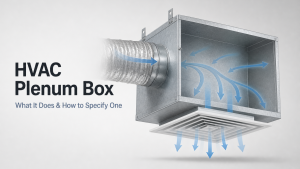
A static pressure box at a fan outlet is the clearest example. The sudden enlargement drops velocity sharply; some pressure is lost to local resistance, but more velocity pressure converts back into static pressure than is lost. The box distributes air, changes direction, attenuates noise, and hands the system extra static pressure to overcome downstream resistance. This is why large-airflow units are frequently fitted with a discharge plenum box when air has to travel a long way.
Regain depends on geometry, not on a formula alone. Gradual, controlled enlargements recover meaningfully; abrupt ones throw most of the energy away as turbulence.
How to Measure Static, Velocity, and Total Pressure
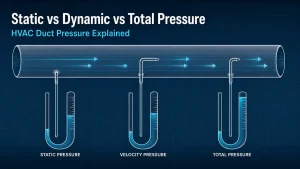
Which pressure you read is decided by how the probe is oriented — nothing else.
- A tap drilled flush with the duct wall, with nothing projecting into the airstream, reads static pressure only.
- A probe facing upstream into the oncoming air reads total pressure.
- Velocity pressure is never measured directly. It is always the difference between the two.
| Measurement need | Typical device |
|---|---|
| Duct or room static pressure | Flush static tap with manometer, digital gauge, or duct-mounted diaphragm gauge |
| Total pressure in the airstream | Impact probe or Pitot tube facing upstream |
| Velocity pressure and duct velocity | Pitot-static tube with a differential pressure instrument |
| Filter loading and continuous monitoring | Differential pressure transmitter or switch |
| Airflow at diffusers and grilles | Capture hood or balometer |
A short discipline list prevents most bad data:
- Choose tap locations in reasonably straight duct, away from fittings and fan discharges.
- Seal the connection so the tap itself does not leak — a concern closely tied to overall duct sealing quality.
- Record whether each reading is static, total, or velocity pressure.
- Take readings at several points to check uniformity rather than trusting one hole.
- Compare results against design intent, not against a previous technician’s unlabeled number.
The classic commissioning dispute starts with a report that simply says “pressure.” At low duct velocities the three values sit close enough together that the ambiguity hides. At high velocity they diverge sharply, and a mislabeled reading looks exactly like a fan performance failure.
1.Pitot Tube Measurement: From Pressure to Air Velocity
A Pitot-static tube picks up total and static pressure in a single insertion and lets the instrument subtract them. That difference is velocity pressure, and velocity follows from it directly — at standard air density, v ≈ 1.29√Pv, with velocity in m/s and Pv in Pa.
Two cautions apply in practice. Air density is part of the relationship, so hot air, high altitude, or process gas conditions require correction rather than standard-air assumptions. And a single reading is a point velocity, not a duct average: converting pressure into a defensible airflow figure requires a proper traverse across the duct cross-section.
Fan Static Pressure vs Fan Total Pressure
This is where pressure terminology stops being academic and starts costing money. Six related terms circulate in fan selection, and they are routinely treated as interchangeable.
| Term | What it means | Primarily used for |
|---|---|---|
| Static pressure (Ps) | Static component of air pressure | Estimating system resistance |
| Velocity pressure (Pv) | Kinetic component, ½ρv² | Velocity and airflow measurement |
| Total pressure (Pt) | Static plus velocity pressure | Energy balance at a point |
| Fan total pressure (FTP) | Rise in total pressure across the fan | Fan energy addition, power and efficiency |
| Fan static pressure (FSP) | Fan total pressure minus fan velocity pressure | Fan rating and catalogue selection |
| External static pressure (ESP) | Resistance outside the equipment casing | AHU and packaged unit selection |
The definition of fan static pressure is not a matter of convention or vendor preference.
Both static and total pressure bases are legitimate for design work:
- Static pressure is the working language of duct design. It is familiar, it matches how component losses are published, and it is what gets measured on site.
- Total pressure is the complete language of fan performance. It reflects the actual energy the fan imparts to the air.
Problems begin when the two are mixed inside one selection. Datasheets and selection software do not all use the same basis, and vendor quotations rarely make the distinction prominent. Adding up a duct system entirely in static pressure losses, then checking that total against a curve plotted in total pressure without subtracting outlet velocity pressure, misstates what the fan actually delivers.
External static pressure needs one qualification that is often left out. ESP broadly refers to the resistance outside the unit — the duct system, terminals, and accessories the equipment must serve — and typically excludes internal losses across coils, internal filters, and casing components. The exact boundary depends on the manufacturer’s equipment definition and rating basis, so confirm what a published ESP figure includes before treating it as available duct pressure.
One more practical point: two fans with identical total pressure can have very different delivery capability. If one runs a much higher outlet velocity, more of its energy sits in velocity pressure and less is available as usable static pressure to overcome duct resistance.
How to Calculate HVAC Duct Pressure
The sequence below is a working framework, not a substitute for design software or manufacturer selection data.
- Establish required airflow from a defined basis — ventilation rate, sensible cooling load and supply temperature difference, air changes, pressurization criteria, or industrial capture requirement.
- Select preliminary duct sizes against sensible velocity ranges. Typical reference bands are 5–8 m/s for main supply ducts, 3–5 m/s for branches, and 4–7 m/s for returns; exhaust velocities depend on contaminant type and noise limits.
- Calculate velocity pressure from the chosen velocity using ½ρv², or the 0.6V² shortcut for standard air.
- Estimate straight-duct friction using friction charts, duct design software, or Darcy-Weisbach methods.
- Add fitting and component losses — duct elbows, transitions, branches, dampers, coils, filters, silencers, louvers, and terminal devices.
- Include honest allowances for dirty filter condition, coil fouling, and balancing contingency. Purposeful margin, not a blanket percentage pad.
- Check the pressure basis before selecting. If the manufacturer’s data is on total pressure, add the outlet velocity pressure to your static estimate; if it is on static pressure, keep the comparison static-to-static.
- Review the duty point for efficiency, part-load behaviour across the VFD range, dirty-filter operation, and acoustic limits.
Step 7 is where most selection errors are created. Step 6 is where most of them are disguised.
Two relationships are worth carrying into that review. System pressure loss varies roughly with the square of airflow (ΔP ∝ Q²), so a system that needs slightly more air needs considerably more pressure. And for a given fan at fixed air density, the fan laws give Q ∝ N, ΔP ∝ N², and power ∝ N³ — a modest speed increase costs a disproportionate amount of energy, which is also why speed reduction saves so much when the system genuinely allows reduced flow.
Common Fan and Duct Problems Caused by Pressure Confusion
Terminology errors rarely announce themselves. They surface later as performance complaints.
- Fan under-selected because outlet velocity pressure or realistic fitting losses were left out, so field airflow never reaches design.
- Fan oversized because a static system total was checked against a total pressure curve, producing throttled dampers and wasted capacity.
- Airflow decaying over time as filters load and coils foul, with no pressure allowance built in.
- Excessive noise from high duct velocity, high pressure drop, or a fan pushed into an inefficient region of its curve — often the real cause behind duct noise complaints.
- Unstable variable-speed operation caused by an oversized fan, an unrealistic static pressure setpoint, or a badly located pressure sensor.
- Commissioning disputes traced back to unlabeled pressure readings rather than any equipment fault.
- System effect from short elbows at the fan inlet or an abrupt discharge, which quietly pulls real performance below the laboratory curve.
Oversizing deserves a specific warning, because it feels conservative. A fan much larger than the system needs brings damper throttling, degraded part-load efficiency, added sound, and awkward commissioning. A correctly selected fan with defensible margin performs better in service.
When static pressure is genuinely too high, the productive fixes are usually upstream of the fan: increase duct size where lifecycle economics justify it, straighten the route with long-radius bends and gradual transitions, specify lower-pressure-drop coils and filters, clean up fan inlet and outlet geometry to reduce system effect, and maintain filters so design pressure drop does not drift upward. The same reasoning applies beyond building HVAC — industrial exhaust, dust collection, and process air systems run higher velocities, which makes total pressure thinking routine rather than optional.
Conclusion
Static, velocity, and total pressure are not three competing answers to the same question. They are three views of the same energy in a moving airstream, and each is the right tool for a different job: static pressure for system resistance, velocity pressure for air speed and airflow measurement, total pressure for fan energy.
Most costly mistakes in duct and fan work come from imprecision rather than difficult physics — an unlabeled field reading, a static system total compared against a total pressure curve, or a velocity pressure quietly ignored at a high-velocity discharge. Getting the labels right costs nothing at design stage and prevents years of excess fan energy, noise complaints, and balancing problems.
A useful next step on any existing system: confirm what basis your fan data and your latest field readings are actually on. If either is ambiguous, resolve that before changing equipment, duct sizing, or fan speed settings.
FAQ
Q1: What is the difference between static pressure and dynamic pressure?
Answer: Static pressure acts on the surfaces around the airstream and is the component associated with overcoming system resistance such as filters, coils, and bends. Dynamic pressure exists only because the air is moving and represents its kinetic energy, calculated as ½ρv².
Q2: Is velocity pressure the same as dynamic pressure?
Answer: Yes. Velocity pressure is the term used in HVAC practice, while dynamic pressure is the more general fluid mechanics term. Both describe the same component and use the same formula.
Q3: What is the formula for total pressure?
Answer: Total pressure equals static pressure plus velocity pressure (Pt = Ps + Pv). Across a fan, fan total pressure is the rise in total pressure from the fan inlet to the fan outlet.
Q4: Can static pressure be negative?
Answer: Yes. Duct static pressure is normally reported relative to atmospheric pressure, so it reads negative wherever duct pressure sits below ambient — typically upstream of a fan in return and exhaust sections. Velocity pressure stays positive whenever flow exists.
Q5: Why does static pressure rise when a duct expands?
Answer: The expansion reduces velocity, so velocity pressure drops and part of that energy converts back into static pressure. This is static regain. Total pressure still falls, because some energy is always lost to turbulence.
Q6: Which pressure matters most for fan selection?
Answer: Neither one alone. Static pressure is the practical basis for estimating duct resistance, while total pressure is the correct energy basis for fan performance. The critical requirement is that your calculation and the manufacturer’s fan curve use the same basis.