Mold in HVAC ducts becomes a building operations problem when moisture allows spores — present in virtually all indoor air — to colonize system components or duct interiors. Because HVAC equipment distributes conditioned air throughout occupied spaces, contamination in or near the airflow path warrants prompt investigation.
The EPA’s position is direct: mold control depends on moisture control. Cleaning contaminated surfaces without identifying and correcting the water or humidity source will produce the same result every time.
This guide covers how to recognize credible warning signs, where moisture failures typically originate, how to investigate and remove contamination, and what prevention looks like as an ongoing maintenance practice.
1.What Does Mold in HVAC Ducts Look Like?
Identifying mold in air ducts requires more than noting a dark stain or discolored patch. Several conditions can produce similar appearances, and visual inspection alone has limits.
What mold growth may look like in ductwork:
- Raised, fuzzy, or splotchy growth on duct liner, insulation surfaces, or register faces
- Dark or discolored patches (black, green, gray, or brown) near drain pans, coil sections, or duct interiors
- Persistent biofilm or slime accumulation in drain pans or condensate components
What may look similar but is not necessarily mold:
- Ordinary dust accumulation on register grilles and vent faces
- Rust or corrosion staining on metal surfaces
- Discoloration from moisture without active mold colonization
A musty or earthy odor when the HVAC system operates is one of the most consistent early indicators. Mold produces microbial volatile organic compounds (mVOCs) that generate a characteristic smell even when no growth is visually accessible.
Other credible warning signs include:
- Visible discoloration or fuzzy growth near supply registers, return grilles, drain pans, or accessible duct openings
- Recurring condensation or standing water around air-handling equipment
- Condensate drain backups or water staining on equipment panels, ceiling tiles, or mechanical room floors
- Elevated indoor humidity that persists despite normal system operation
- Occupant complaints about irritation or recurring respiratory discomfort — these warrant investigation but are not, by themselves, diagnostic
Dark staining and musty odors are investigation triggers, not confirmation of contamination. Accurate diagnosis requires tracing the moisture source, inspecting accessible components, and — in cases where contamination is not visible but strongly suspected — professional assessment.
2.What Causes Mold in HVAC Ducts?
Duct interiors are often where visible evidence appears, but the moisture source is almost always upstream — typically in the air handler or in components responsible for condensate management and humidity control. Effective response begins with tracing that source, not with treating the duct surface.
2.1 Condensate Drain and Drain Pan Problems
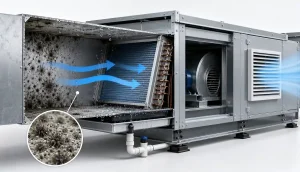
The condensate drainage system removes water that forms when warm, humid air contacts the cold evaporator coil. Under normal operation, condensate drips from the coil into a drain pan and exits through a drain line.
When the drain pan is clogged with biofilm, scale, or debris — or when the condensate line is blocked or inadequately sloped — water accumulates in a persistently wet area directly adjacent to the coil and blower section. This is among the most common origins of HVAC mold in commercial buildings.
Routine inspection and flushing of condensate pans and drain lines should be a scheduled maintenance item, not an ad hoc response to a visible leak.
2.2 Wet Duct Insulation and Coil Condensation
Evaporator and chilled-water coils operate at surface temperatures below the dew point during cooling season. Condensation is normal — what matters is whether moisture is properly drained and whether adjacent materials remain dry.
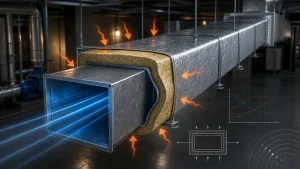
Fibrous duct liner insulation near the coil section is a common problem area. Saturated fibrous insulation cannot be effectively cleaned and should be removed and replaced. The EPA is explicit on this point: porous materials that have been wetted and become moldy cannot be reliably restored through surface cleaning alone.
Coil fouling also contributes. Dirt accumulation on coil fins restricts airflow and can affect drainage patterns, creating damp conditions in the air stream downstream.
2.3 Duct Leaks and Humidity Control
Return ductwork running through unconditioned spaces — crawl spaces, ceiling plenums, or mechanical chases — is vulnerable to moisture infiltration when duct joints are not sealed. Negative pressure in return ducts draws in humid, dusty air from unconditioned areas, increasing the moisture load throughout the system.
Supply duct leaks present a different risk: conditioned air escaping into warm unconditioned spaces can produce condensation on duct exteriors and, in some configurations, on interior surfaces as well.
Poor outdoor-air control — improperly sized or poorly sealed intakes, inadequate economizer management, or building-envelope gaps near mechanical rooms — can add latent moisture loads that exceed the system’s dehumidification capacity.
2.4 Filtration, Airflow, and Equipment Problems
A clogged filter restricts airflow across the evaporator coil and can affect cooling performance and condensate behavior. The resulting impact on humidity and dehumidification depends on system design, operating conditions, and the severity of the restriction. Inspect filters and coil performance together when investigating persistent humidity problems rather than treating filter condition as the sole variable.
Equipment sizing is a less obvious but well-documented contributor. A cooling unit that is too large for its load may cycle off quickly, satisfying temperature demand before completing a dehumidification run. In humid climates, persistent humidity that does not improve with standard maintenance warrants a review of system capacity, controls, and whether dedicated dehumidification is appropriate.
3. How to Remove Mold from HVAC Ducts
Effective removal addresses the system as a whole. Sequence matters: moisture-source correction must be completed alongside or before surface cleaning, or contamination will return regardless of cleaning thoroughness.
3.1 Identify and Correct the Moisture Source
Before any cleaning begins, locate and correct the condition that created the moisture. This typically means:
- Inspect the condensate drain pan — clear any standing water, biofilm, or debris, and verify that the drain line flows freely.
- Check condensate line slope and confirm unobstructed drainage to exit.
- Assess coil cleanliness and airflow.
- Identify any duct leaks in unconditioned areas and plan for sealing.
- Verify that indoor humidity is under control, particularly during high-latent-load periods.
- Address any water intrusion, plumbing leaks, or building-envelope gaps contributing to elevated moisture.
Until the moisture source is corrected, any cleaning performed is a temporary measure.
3.2 Clean Metal Ducts and Nonporous Components
For nonporous surfaces — metal duct interiors, coil housings, blower housings, drain pans, and register faces — cleaning follows physical removal first:
- Use HEPA-equipped vacuum equipment to remove loose debris before applying any cleaning agents.
- Scrub accessible hard surfaces with appropriate detergents or cleaning solutions and dry thoroughly.
- Where antimicrobial products are considered necessary after physical cleaning, verify that the product label specifically permits the intended application and substrate. The EPA notes that chemical treatment inside ductwork — particularly ducts with fibrous liner — requires careful evaluation and is not a substitute for physical removal and source correction. Do not apply sealants or encapsulants as a primary treatment in lieu of cleaning.
Containment appropriate to the scope of work helps prevent cross-contamination to occupied areas during cleaning.
3.3 Replace Wet or Moldy Porous Insulation
Fibrous duct liner, flexible duct sections with contaminated interior lining, and other porous insulation materials that have been wetted or that show mold growth should be removed and replaced — not cleaned in place. The EPA’s guidance is clear: porous materials that cannot be dried effectively and from which mold cannot be fully removed should be discarded.
This applies to insulation adjacent to coil sections, liner inside air handlers, and any porous material with evidence of sustained moisture contact. Attempting to clean and reuse wet fibrous insulation typically delays rather than resolves the problem.
3.4 When Professional Remediation Is Needed
In-house maintenance is appropriate for accessible, early-stage contamination where the moisture source is identified and correctable. Escalate to qualified HVAC and remediation professionals when:
- Contamination has spread through multiple duct sections or into inaccessible areas requiring inspection cameras or duct access panels
- Growth returns after prior cleaning
- The event followed significant water intrusion, flooding, or a prolonged drainage failure
- Porous materials — duct liner, surrounding insulation, ceiling tiles — are affected and require replacement
- The moisture source involves duct leakage, equipment sizing, controls issues, or building-envelope defects beyond routine maintenance scope
- The building houses health-sensitive occupancies (medical facilities, schools, or spaces occupied by immunocompromised individuals)
When engaging contractors, define the scope clearly: inspection methodology, moisture-source correction, affected system boundaries, containment approach, cleaning or replacement criteria, and post-work verification. A proposal limited to chemical application without physical removal and source correction does not meet remediation standards.
For applicable commercial projects, NADCA (National Air Duct Cleaners Association) member contractors follow published standards for HVAC system inspection and cleaning that cover the full air distribution system — not duct surfaces alone.
4. Is Mold in HVAC Ducts Dangerous?
The health significance of mold in HVAC systems depends on the type and extent of contamination, how the system distributes air, and the health profile of building occupants.
According to the EPA, mold exposure can produce:
- Allergic reactions (sneezing, runny nose, red eyes, skin irritation) in sensitive individuals
- Asthma attacks in people with mold-related asthma
- Irritation of the eyes, skin, nose, throat, and lungs — even in people without known mold allergies
People with compromised immune systems, chronic respiratory conditions, or mold sensitivities face greater risk. Healthy adults in low-contamination environments may experience no noticeable symptoms at all.
What this means practically:
- Visible mold contamination in components directly within the airflow path — drain pan, coil section, blower, duct interiors — warrants prompt corrective action regardless of current symptom levels.
- Odors and staining near vents are investigation triggers. Document and inspect; do not dismiss, but also do not assume the worst before completing an assessment.
- If occupants report persistent symptoms that resolve when they leave the building and return when they come back, this pattern is worth investigating — it does not confirm HVAC mold specifically, but it justifies a thorough system inspection.
The EPA does not set federal indoor mold standards or thresholds; there is no official “safe” or “unsafe” spore count. The practical guidance is: visible mold growth in the system should be removed, and the moisture conditions that supported it should be corrected.
5. How to Prevent Mold from Returning
Prevention in a commercial or industrial building is not a one-time cleaning — it is a maintenance program that addresses the conditions mold requires.
5.1 Control Indoor Humidity
Keep indoor relative humidity below 60%; the EPA recommends targeting 30–50% for both comfort and mold prevention. During high-humidity seasons, verify that dehumidification is operating and that controls are functioning correctly.
Buildings in humid climates with persistent latent load problems may benefit from dedicated whole-building dehumidification systems. Standard HVAC cooling alone is sometimes insufficient for dehumidification when equipment is oversized, cycling is frequent, or outdoor air infiltration is high.
5.2 Maintain Condensate Drainage and Cooling Coils
Condensate pans and drain lines are the most direct moisture-management components in the system. The following table outlines recommended inspection focus areas. These intervals are starting points; actual frequency should be adjusted based on manufacturer requirements, equipment operating hours, environmental humidity, and observed contamination patterns.
| Component | Suggested Starting Frequency | What to Inspect |
|---|---|---|
| Air filters | Monthly to quarterly (per filter type and loading) | Condition, loading rate, bypass gaps around frame |
| Condensate drain pan | Monthly during cooling season | Standing water, biofilm, debris, drain function |
| Condensate drain line | Quarterly | Flow, slope, blockage, biological growth |
| Evaporator / cooling coil | Annually (visual); per manufacturer for detailed service | Cleanliness, condensate drainage pattern, fin condition |
| Duct insulation and liner | Annually | Moisture, physical damage, delamination, odor |
| Indoor RH monitoring | Continuously (BAS) or seasonal manual checks | Readings above 60% trigger system investigation |
The EPA recommends drying water-damaged materials within 24–48 hours to prevent mold from establishing. A condensate pan overflow that sits unaddressed for several days can create a remediation project that same-day response would have avoided.
5.3 Inspect Duct Insulation and Air Leaks
Return duct sealing and insulation condition should be assessed periodically — particularly after renovation, following water damage events, or when persistent humidity problems suggest air infiltration from unconditioned spaces. A fixed calendar interval is less useful than inspection tied to operational changes and observed conditions.
Track patterns over time: repeated drain blockages, filters loading faster than expected, or recurring humidity spikes are system signals that standard maintenance frequency may not match actual operating conditions. These patterns are worth investigating before they escalate into remediation projects.
6. Frequently Asked Questions About Mold in HVAC Ducts
Q1: Can mold actually grow inside metal air ducts?
Answer: Bare metal surfaces are not an ideal substrate for mold, but most commercial ductwork contains fibrous liner insulation, accumulated dust, and organic debris that can support growth when moisture is present. Contamination in ductwork typically develops on liner surfaces, in drain components, or on coil sections — not on bare sheet metal alone.
Q2: Does a musty smell from HVAC vents always mean there is mold?
Answer: Not necessarily. Musty odors can result from biofilm on coil or drain pan surfaces, saturated duct liner, accumulated organic debris, or mold growing in adjacent building materials that the HVAC return is drawing air through. A persistent musty smell during system operation is a reliable trigger for inspection — not a definitive diagnosis. Investigate the source before drawing conclusions.
Q3: Should the HVAC system be shut down if mold contamination is suspected?
Answer: The EPA advises against running an HVAC system if it is known or suspected to be contaminated with mold, as continued operation can spread contamination through the building. If visible mold is confirmed in components directly in the airflow path, restrict or isolate that equipment and consult a qualified professional before restarting. Odor and staining alone — without confirmed contamination — do not automatically require full shutdown, but they do require prompt assessment.
Q4: Is mold testing always necessary before starting remediation?
Answer: No. The EPA’s position is that where visible mold growth is present, sampling is generally unnecessary before beginning remediation — the corrective action is the same regardless of species. Testing is most useful for post-remediation verification, for investigating suspected but non-visible contamination, or when scope decisions require a specific result. Any sampling should be conducted by qualified professionals following established protocols.
Q5: Can duct cleaning alone solve an HVAC mold problem?
Answer: No. Duct cleaning addresses what is on accessible duct surfaces; it does not correct the moisture conditions that caused contamination. Without repairing drain failures, replacing wet insulation, sealing duct leaks, or addressing humidity-control deficiencies, contamination will return. Duct cleaning is one component of properly scoped remediation — not the solution on its own.
Q6: Is mold in HVAC ducts dangerous?
Answer: The health impact depends on contamination extent, system configuration, and the health profile of building occupants. The EPA recognizes mold as a potential cause of allergic reactions, asthma exacerbation, and respiratory irritation, particularly for sensitive individuals. Visible contamination in the airflow path warrants removal regardless of current symptoms. There are no federal indoor mold standards — the practical guidance is to remove visible growth and correct the moisture source.
7. The Bottom Line
Every recurring HVAC mold problem points back to one root cause: moisture that was not adequately managed, drained, or removed. Surface cleaning addresses visible evidence. Only moisture-source correction prevents the problem from returning.
For facility and maintenance teams, the most cost-effective approach is preventive — scheduled condensate system maintenance, humidity monitoring, and prompt response to water events. When contamination does occur, scope the response to include the full affected system: moisture source, coil and drain components, insulation condition, and duct integrity — not just the most visible surfaces.
Remediation is complete only when the moisture conditions that supported growth have been verified as corrected. If recurring mold or unexplained humidity problems persist despite routine maintenance, an HVAC system assessment— covering equipment sizing, controls, dehumidification capacity, and duct integrity — is a more productive next step than another cleaning cycle.