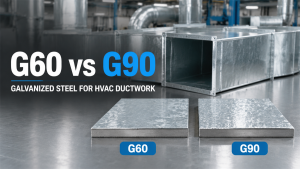


1. G60 vs. G90 Galvanized Steel: The Short Answer
If you’ve seen “G60” and “G90” on a duct specification or a steel mill certificate and weren’t sure what separates them, you’re not alone. Both terms describe how much zinc is bonded to a sheet of galvanized steel, and that difference affects how long the material resists rust in a given environment.
This guide breaks down what G60 and G90 actually mean, how much corrosion protection each one really adds, and how to match the right coating to indoor ducts, rooftop units, and everything in between — without over-specifying material you don’t need.
G60 and G90 are both ASTM A653 zinc coating designations, and G90 simply carries more zinc than G60. The number refers to the total weight of zinc applied to both sides of the sheet, measured in ounces per square foot (oz/ft²): G60 is commonly cited at 0.60 oz/ft², and G90 at 0.90 oz/ft².
More zinc means a thicker protective layer and generally better resistance to rust — but it doesn’t change the steel’s thickness, strength, or duct gauge. Choosing between them is an exposure decision, not a strength decision.
| G60 | G90 | |
|---|---|---|
| Total zinc coating (both sides) | ~0.60 oz/ft² | ~0.90 oz/ft² |
| Relative corrosion resistance | Moderate | Higher |
| Typical setting | Dry, conditioned interior ductwork | Damp, humid, or weather-exposed areas |
| Relative material cost | Lower | Higher |
| Governing standard | ASTM A653/A653M | ASTM A653/A653M |
2. What G60 and G90 Actually Mean
G60 and G90 are coating-weight classes defined under ASTM A653/A653M, the standard specification for hot-dip galvanized steel sheet. The number after the “G” is a shorthand for the total mass of zinc bonded to the steel, not a grade of steel strength or a thickness code.
Under ASTM A653/A653M, G60 and G90 refer to minimum triple-spot test (TST) coating weights of 0.60 and 0.90 oz/ft², measured across both sides of the sheet combined. The standard also sets separate, lower minimums for single-spot testing and for one-side coverage, so the total figure should not simply be divided in half and treated as a per-side guarantee. When reviewing a mill certificate, check which test method the reported value is based on.
It’s also worth distinguishing two terms that often get used interchangeably: coating weight (the mass of zinc per unit area, in oz/ft² or g/m²) and coating thickness (the physical depth of that zinc layer, usually in mils or micrometers). They describe the same zinc layer from two different angles, and ASTM A653 and related references typically report both, so a spec sheet may list either figure depending on the source.
Zinc coatings are typically applied through a hot-dip process, where cleaned steel sheet is run through a bath of molten zinc at roughly 850°F (454°C). The reaction between the zinc and the steel surface forms a bonded, sacrificial layer that corrodes before the base metal does. G60 and G90 aren’t the only classes available — lighter coatings like G30 and G40, and heavier ones like G185, exist for applications outside the HVAC range, but G60 and G90 remain the two most commonly specified weights for automatic duct production line feedstock and other galvanized steel coil used in ductwork and building products.
A few things G60/G90 does not tell you:
- Base steel thickness or duct gauge
- Yield strength or lock-forming grade
- Pressure class or structural suitability of the duct
- Whether accessories (fasteners, tie rods, dampers) share the same coating
3. How Coating Weight Affects Corrosion Protection
Zinc protects steel two ways: it acts as a physical barrier, and it corrodes preferentially (sacrificially) if the surface is scratched or cut, which is why galvanized edges resist rust even after fabrication. A heavier coating simply gives you more of that sacrificial material to work with before red rust starts forming on the base steel.
The following estimates are reproduced from SMACNA’s technical paper, “Effects of Imposing a Universal Requirement of G-60, G-90 Coating on All Components of Ductwork,” prepared by SMACNA’s Director of Technical Services. They are historical reference values, not a performance guarantee for a current project:
| Exposure | G60 (reference estimate) | G90 (reference estimate) |
|---|---|---|
| Indoor, conditioned space | ~34 years to first significant rust | ~54 years to first significant rust |
| Outdoor, rural | ~8–16 years to first rust | ~12–25 years to first rust |
| Outdoor, urban/suburban | ~2.5 years to first rust | ~4 years to first rust |
| Outdoor, industrial | ~1.5–2.5 years to first rust | ~2.5–4 years to first rust |
| Outdoor, marine/coastal | ~1.5–4 years to first rust | ~2.5–6 years to first rust |
A few limitations are worth flagging before using these numbers in a proposal or spec discussion:
- The indoor figures (34/54 years) describe time to first significant rust in building-interior service and come from a different evaluation basis than the outdoor figures, which describe time to first rust under weather exposure — the two rows aren’t directly comparable to each other.
- These are historical reference values from SMACNA’s technical literature, not a lab test run on a specific product or project.
- Actual service life still depends on humidity, condensation cycling, airborne pollutants, installation damage, and maintenance — not the G-rating in isolation.
Treat the table as a way to compare relative durability between G60 and G90 in similar conditions, not as a warranty figure to quote to a customer.
Source: SMACNA, “Effects of Imposing a Universal Requirement of G-60, G-90 Coating on All Components of Ductwork.”
4. How to Choose G60 or G90 for Different HVAC Ductwork Environments
Most HVAC coating decisions come down to one question: how much moisture will this duct realistically see over its service life? The table below is a starting point, not a substitute for checking your project specification or applicable code — and G90 is not an automatic fix for every harsh environment.
| Environment | Typical starting point | Why |
|---|---|---|
| Dry, conditioned interior ductwork | G60 | Low moisture exposure, cost-effective, widely available |
| Humid indoor spaces (basements, crawlspaces, garages) | G60 or G90 | Depends on condensation risk, ventilation, and project spec |
| Outdoor ductwork (rooftop units, curbs, exterior runs) | G90, per applicable standard and project spec | Direct weather exposure, higher condensation risk |
| Coastal or aggressive industrial environments | G90 as a starting point; evaluate additional protection | Salt spray and airborne chemicals can outpace standard zinc coatings |
4.1. When G60 Is the Practical Choice
G60 is the common starting point for a large share of commercial and residential interior ductwork — standard trunk lines, returns, and branch ducts in conditioned spaces where condensation is unlikely. SMACNA’s HVAC Duct Construction Standards use G60-coated galvanized steel as the basis for duct gauge and construction tables, unless a project specification calls for something heavier. Because it’s the most commonly stocked coating weight, lead times and pricing are usually the most favorable.
4.2. When G90 Is Worth Considering
G90 is commonly evaluated for damp basements, crawlspaces, parking garages, rooftop curbs, and duct runs exposed to outdoor air or frequent condensation. For high-salt coastal sites or environments with aggressive industrial pollutants, G90 is a reasonable starting point, but the project specification or applicable standard should confirm whether supplemental coatings or alternative materials are warranted — zinc coating weight alone doesn’t scale indefinitely with exposure severity.
4.3. Does G90 Affect HVAC Duct Fabrication?
G60 and G90 sheet are both routinely processed on standard duct fabrication lines — shearing, forming, bending, lock-forming, and joining. Choosing one coating over the other doesn’t change the base steel thickness, so it isn’t a substitute for selecting the correct duct gauge for a given size or pressure class.
Fabricators should still confirm forming and joining parameters against the actual material specification and equipment requirements, and take care during cutting, forming, and handling to avoid scratching or removing the zinc layer, since damaged coating loses its protective value at that spot. Beyond that general handling practice, this article doesn’t make a claim about a measurable difference in formability between G60 and G90 — if your project has specific forming concerns, confirm with your steel supplier or fabrication equipment provider.
5. Specify the Whole Duct Assembly — Not Just the Sheet
A specification that simply says “G90 throughout” can create more problems than it solves, because duct assemblies include far more than flat sheet. Reinforcements, tie rods, hangers, access doors, and fasteners often follow different coating practices — and in some cases, matching sheet-grade coatings on every accessory isn’t readily available without special order.
A commonly cited example: standard screws, rivets, bolts, and other fastening components may use different protective coating systems and thicknesses from the galvanized sheet itself. Their corrosion resistance should be evaluated against the applicable fastener specification and project requirements rather than assumed to automatically match the G60 or G90 designation of the duct panels. Where a slip-and-drive duct connection or similar fitting is used, confirm its coating and compatibility with the surrounding sheet separately.
Components to check individually when writing or reviewing a duct spec:
- Duct panels (the sheet itself)
- Reinforcement angles and stiffeners
- Tie rods and hangers
- Fasteners (screws, rivets, bolts)
- Access doors and dampers
- Any concealed components in mixed-material assemblies
Treating these as a single line item is a common source of bid confusion. Calling out coating requirements by component, not just by sheet, keeps the specification realistic and easier to price — this is the kind of detail that rectangular duct fabrication equipment and experienced fabricators account for when quoting a job against an applicable duct construction standard.
6. Coating Weight Is Not Duct Gauge
It’s worth repeating because it’s one of the most common mix-ups on a spec sheet: the G-number describes zinc coating, and the gauge number describes steel thickness. A heavier coating doesn’t make a thinner sheet stiffer, and a lighter coating doesn’t weaken a thicker one. They’re selected independently, based on two different sets of criteria.
- Coating weight (G60/G90): selected for corrosion exposure — indoor vs. outdoor, dry vs. humid.
- Duct gauge: selected for duct size, span length, pressure class, and reinforcement requirements, per the applicable construction standard.
SMACNA’s HVAC Duct Construction Standards use G60-coated galvanized steel as the basis for duct gauge and construction tables in rectangular and round duct. However, that’s a baseline for the standard’s sizing tables, not a universal rule — the coating weight actually required on a given project depends on the applicable project specifications, code, and exposure conditions. Always confirm which edition of the governing HVAC duct construction standards applies to your project before assuming a default coating or gauge.
7. Weighing Total Cost and Procurement Risk
G90 costs more than G60 because it uses more zinc and typically takes longer in the galvanizing line. For many projects, that premium is minor compared to the cost of recoating, patching, or replacing corroded duct sections down the road — but it’s not automatically the better value everywhere.
A few practical cost and sourcing considerations:
- G60 is the more widely stocked coating, so standard sheet is usually easier to source quickly.
- Blanket G90 requirements for every component (including accessories) can extend lead times and add cost without a clear performance benefit in dry interior spaces.
- For long-term outdoor or coastal installations, the lower maintenance burden of G90 can offset its higher upfront price over the life of the system.
- Mixed specifications — G60 for interior runs, G90 for exposed sections — are common and can control cost without sacrificing protection where it matters.
Before finalizing a spec that goes beyond standard G60/G90 sheet, it’s worth a quick call to your fabricator or supplier to confirm availability and lead time, especially if accessories are included in the coating requirement.
8. G60/G90 Specification and Receiving Checklist
Use this checklist when writing a spec, reviewing a submittal, or receiving material on a job site:
- Confirm the governing document. Identify the project specification, applicable code, and the current edition of the referenced standard (don’t assume an older spec excerpt still applies).
- State the coating by component. Specify G60 or G90 separately for panels, reinforcements, tie rods, hangers, and fasteners — don’t assume one grade covers everything.
- Keep gauge separate. Confirm duct thickness/gauge based on size, span, and pressure class, independent of the coating decision.
- Match coating to exposure. Dry interior spaces generally don’t need G90; damp, rooftop, or coastal locations usually shouldn’t rely on G60 alone.
- Check documentation. Ask for mill certificates or coating identification confirming the specified G-rating meets ASTM A653/A653M.
- Verify lead time early. Confirm availability for any non-standard coating requirement on accessories before it affects the schedule.
- Plan for field damage. Agree in advance how cut edges, drilled holes, or scratched coating will be touched up or protected.
9. Conclusion
G60 and G90 solve the same problem — rust prevention — at two different levels of protection, and the right choice depends on how much moisture and exposure your ductwork will actually see, not on defaulting to the heavier option everywhere. G60 covers the majority of dry, conditioned interior duct runs cost-effectively, while G90 earns its place in damp, rooftop, coastal, or industrial environments where the extra zinc translates into real maintenance savings.
The practical next step is to specify coating weight by component rather than by blanket statement, confirm gauge and pressure class separately from corrosion protection, and check lead times before a non-standard requirement lands on your fabricator’s desk mid-project.
10. FAQ
Q1: Is G90 twice as corrosion-resistant as G60?
Answer: No. G90 carries about 50% more zinc than G60 (0.90 oz/ft² vs. 0.60 oz/ft²), which generally extends corrosion resistance, but it isn’t a simple doubling of protection or service life — actual performance still depends on the environment.
Q2: Does G90 make ductwork stronger or thicker than G60?
Answer: No. Coating weight and steel thickness (gauge) are separate specifications. G90 adds corrosion protection, not structural strength — gauge and reinforcement are selected based on duct size, span, and pressure class.
Q3: Do fasteners and tie rods need the same coating as the duct panels?
Answer: Not necessarily. Fasteners, tie rods, and similar accessories often use different coating systems and thicknesses than the sheet, so their corrosion resistance should be checked against the applicable fastener specification rather than assumed to match G60 or G90. Specify coating requirements by component to avoid sourcing delays.
Q4: Can I use G60 for a rooftop or outdoor duct run?
Answer: It’s generally not recommended as the primary protection for sustained outdoor exposure. G90 or supplemental coatings are the more common choice for rooftop curbs, exterior runs, and other weather-exposed ductwork, subject to the applicable project specification.
Q5: What standard governs G60 and G90 galvanized steel?
Answer: Both are coating-weight classes under ASTM A653/A653M, the standard specification for hot-dip galvanized steel sheet. Duct construction requirements referencing these coatings are typically found in the applicable HVAC duct construction standard in force for your project.
Q6: Is G90 galvanized steel required for outdoor ductwork?
Answer: Not automatically. Outdoor exposure often calls for G90 or heavier protection, but the actual requirement depends on the governing project specification, applicable construction standard, and real exposure conditions — not a blanket rule that every outdoor project needs G90.
Q7: What is the difference between G60 and G90 coating thickness?
Answer: G90 carries roughly 50% more total zinc than G60 (0.90 oz/ft² vs. 0.60 oz/ft², per ASTM A653 triple-spot test minimums), which corresponds to a thicker zinc layer. Coating weight and coating thickness describe the same zinc layer, just measured as mass per area versus physical depth.