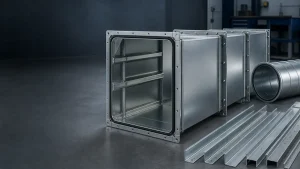
SMACNA duct construction classes define the fabrication requirements that make ductwork structurally suitable for a given operating pressure. In practice, the assigned static pressure class is the primary input. Combined with duct dimensions, material, and pressure direction, it determines the minimum sheet gauge, permitted seam and joint types, and reinforcement requirements the fabricator must meet.
According to SMACNA’s HVAC Duct Construction Standards – Metal and Flexible (4th edition), seven standard pressure classes are recognized — from ½ in. w.g. for low-velocity distribution to 10 in. w.g. for heavy industrial systems — each with corresponding construction requirements based on duct size and configuration.
This article explains how those classes work, what each one demands from a construction standpoint, and what belongs on a duct schedule before a fabrication package is released. For a broader overview of SMACNA duct standards— including leakage classifications, material specs, sizing principles, and installation requirements — see our companion guide.
1.What Is a SMACNA Duct Construction Class?
SMACNA — the Sheet Metal and Air Conditioning Contractors’ National Association — publishes the industry-standard rulebook for how commercial ductwork is fabricated and installed. The current edition is HVAC Duct Construction Standards – Metal and Flexible, 4th edition, accredited by ANSI.
The standard does not determine duct sizing or airflow. It answers one specific structural question: given the pressure a duct section must handle and its physical dimensions, how must that duct be built to hold rated pressure without deflection, leakage, vibration, or structural failure?
The answer is driven by static pressure class. Once a pressure class is assigned, SMACNA’s construction tables specify the minimum sheet thickness, allowable seam and joint types, and required reinforcement for that combination of pressure and duct size.
Four things must be specified separately on a complete duct construction package:
- Pressure class — the structural construction input
- Construction details — gauge, seams, joints, reinforcement
- Sealing requirement — where and how connections are sealed
- Material and environment — substrate, finish, and special conditions
A duct schedule that says only “SMACNA compliant” has communicated none of these with enough precision to release a fabrication package.
2.SMACNA Duct Pressure Classes: ½ to 10 in. w.g.
According to SMACNA’s HVAC Duct Construction Standards, static pressure class is expressed in inches of water gauge (in. w.g.) and covers both positive and negative pressure service. Seven standard classes are recognized:
| Pressure Class | Pressure Direction | Typical Application |
|---|---|---|
| ½ in. w.g. | Positive or negative | Low-velocity return, exhaust, short supply branches |
| 1 in. w.g. | Positive or negative | General commercial supply, return, and exhaust distribution |
| 2 in. w.g. | Positive or negative | Primary supply duct, downstream of central AHUs |
| 3 in. w.g. | Positive or negative | Larger systems, main trunk duct, upstream of terminal units |
| 4 in. w.g. | Positive or negative | Higher-static supply systems, shaft duct on multi-story buildings |
| 6 in. w.g. | Positive or negative | High-pressure specialty and industrial applications |
| 10 in. w.g. | Positive or negative | Heavy industrial, process ventilation, high-static specialty systems |
The design engineer assigns a pressure class based on the system’s static pressure distribution and duct location. The fabricator applies the corresponding SMACNA construction requirements. Pressure class should be stated per system or per bounded duct segment — assigning one class to an entire project is a common error when different zones operate at different pressures.
2.1 Positive vs. Negative Pressure: Why Polarity Must Be Stated
Pressure polarity is as important as pressure magnitude — and it is routinely omitted from duct schedules.
Positive pressure duct is pressurized from inside. Structural failure tends toward outward panel bulge. Negative pressure duct — return plenums, exhaust systems, fan inlet connections — is under vacuum. Here the failure mode is inward collapse, and construction that resists outward deflection does not automatically resist inward buckling.
SMACNA addresses positive and negative pressure separately within its construction tables. For any duct on the suction side of a fan, the schedule must state both the pressure class and the polarity (positive or negative service). Defaulting to positive pressure across the board is one of the more costly specification oversights in commercial duct fabrication.
3. How Pressure Class Determines Duct Gauge and Reinforcement
The underlying logic in SMACNA’s construction tables is structural: as operating pressure increases, or as the largest unsupported panel dimension grows, the tendency for that panel to deflect under load increases. The construction response — heavier gauge, more robust joints, closer reinforcement, or a combination — scales accordingly.
Two variables govern every table lookup:
- Pressure class — the maximum operating static pressure for that duct section
- Largest duct dimension — the longest unsupported panel span (rectangular); diameter (round)
A 60-inch-wide panel and a 12-inch-wide panel at the same pressure class require different construction, because the wider panel deflects far more under the same pressure load. A gauge specification that references only pressure class without duct dimensions is structurally incomplete.
The table below illustrates how the relationship between pressure class and duct dimension shapes the general construction response. These are directional guidelines, not project specifications. For actual gauge, reinforcement size, and spacing requirements, consult the applicable SMACNA edition and the project’s contract documents.
| Pressure Class | Largest Dimension | General Construction Response |
|---|---|---|
| 1 in. w.g. | Small (≤24 in.) | Lighter gauge / standard reinforcement spacing |
| 1 in. w.g. | Large (>48 in.) | Heavier gauge or closer reinforcement |
| 2 in. w.g. | Small | Moderate gauge step-up from 1 in. w.g. |
| 2 in. w.g. | Large | Heavier gauge + reinforcement |
| 4 in. w.g. | Small | Substantially heavier construction than low pressure |
| 4 in. w.g. | Large | Heavier gauge + closer reinforcement + more robust joints |
| 6–10 in. w.g. | Any | Heaviest construction; engineered joint systems required |
For exact gauge and reinforcement requirements, refer to the applicable SMACNA HVAC Duct Construction Standards table for the specific pressure class, duct dimensions, and material.
3.1 Sheet Metal Gauge
Gauge is the most visible construction variable. In commercial HVAC, galvanized steel is the default SMACNA substrate, and its gauge tables are the baseline. Higher pressure classes and larger duct dimensions move toward heavier sheet.
Under-specified gauge has predictable consequences:
- Oil-canning — visible panel distortion and cycling under pressure fluctuation
- Noise and vibration — panel resonance as the system pressurizes and depressurizes
- Leakage — seam and joint failure driven by panel movement under load
- Failed inspection — structural non-conformance found at leakage testing or commissioning
When the specification calls for stainless steel, aluminum, or a coated substrate — or when the application involves moisture, chemicals, or elevated temperature — galvanized-steel gauge assumptions do not transfer. These situations require an explicit material specification with appropriate thickness callouts.
3.2 SMACNA Duct Seams and Transverse Joints
Every duct section involves two types of connections, and SMACNA governs both.
Longitudinal seams form along the length of the duct when sheet is rolled or bent to shape. Common types include Pittsburgh lock and snap lock seams. Permissible seam types depend on duct shape, pressure class, and pressure polarity.
Transverse joints connect duct sections end to end — and this is where most leakage risk accumulates on a commercial system:
| Joint Type | Typical Pressure Class Range | Notes |
|---|---|---|
| Drive slip / S-slip | ≤1 in. w.g. | Common on low-pressure branch duct |
| Standing seam | Low–medium | Formed from the duct sheet itself |
| TDC / TDF flange | 2–4+ in. w.g. | Proprietary flanged system; corner clips and gasketing required |
| Heavier flanged / welded | 6–10 in. w.g. | Engineered connections; full perimeter sealing required |
Joint selection must be compatible with the project’s sealing requirement. A joint that performs adequately at 1 in. w.g. with Seal Class C will not meet the structural or leakage demands of a 4 in. w.g. system with Seal Class A.
3.3 Reinforcement and Stiffening
Where sheet gauge alone cannot hold a panel within acceptable deflection limits, SMACNA requires external stiffening — angle iron, flat bar, tie rods, or other approved methods applied at intervals the standard specifies by pressure class and duct dimension.
Reinforcement spacing is a structural requirement, not a fabrication preference. Eliminating or spacing out stiffeners to reduce material cost directly increases panel deflection under operating load.
Gauge, reinforcement, and joint selection interact. SMACNA allows substitution trade-offs — a heavier gauge can reduce reinforcement frequency; a robust flanged joint system carries some of the structural load that intermediate stiffeners would otherwise provide. These are legitimate cost-optimization tools, but only when applied correctly against the applicable SMACNA tables.
4.Construction Class vs. Seal Class vs. Leakage Class
This distinction is the most frequently misunderstood area in duct specifications — and the one most likely to produce a non-conforming installed system.
Construction class / pressure class defines how the duct is structurally built: gauge, seam type, joint type, reinforcement. It determines whether the duct can physically hold rated pressure.
Seal class defines where and how duct connections are sealed. Per SMACNA:
- Seal Class A — all longitudinal seams, transverse joints, and connections sealed
- Seal Class B — transverse joints and connections sealed; longitudinal seams sealed above certain pressure thresholds
- Seal Class C — transverse joints sealed only
Leakage class establishes the maximum permitted air loss rate through the assembled duct system, typically verified by pressurization testing per the SMACNA HVAC Air Duct Leakage Test Manual.
These are three independent requirements. A duct built to the correct pressure class can still fail leakage testing if seal class was not specified or applied. A high seal class does not compensate for under-built joints. A complete duct specification communicates all three:
- Pressure class + positive/negative designation
- Seal class (A, B, or C)
- Leakage performance target and test scope (if applicable)
5.How to Specify SMACNA Duct Construction on Drawings
“SMACNA compliant” is not a fabrication specification. A duct schedule that lacks the inputs below forces the fabricator to assume — and assumptions found after steel is cut become change orders.
The clearest method is a duct schedule that identifies each system or zone separately. Before releasing any package for fabrication, confirm the following:
5.1 Duct Construction Specification Checklist
System and geometry
- System or segment identification; airflow direction (supply, return, exhaust, process)
- Duct shape: rectangular, round, or flat oval
- Governing dimension: largest side (rectangular) or diameter (round)
Pressure and structural
- Pressure class (in. w.g.) — per system or segment, not project-wide
- Pressure polarity: positive or negative service
- Applicable SMACNA edition
Construction details
- Required or permitted longitudinal seam types
- Required or permitted transverse joint system
- Reinforcement type, size, and maximum spacing — or reference to applicable SMACNA table
- Approved construction alternatives, if any
Sealing and leakage
- Seal class (A, B, or C, or project-specified)
- Leakage performance target (if applicable)
- Testing scope, method, and access requirements
Material and environment
- Sheet material and finish: galvanized, stainless, aluminum, coated
- Liner or insulation requirements
- Special coatings, ratings, or UL/fire listings
Coordination
- Contract documents and code references
- Submittal and shop drawing requirements; approval responsibilities
6.Common SMACNA Duct Construction Mistakes
Most duct specification problems share a single root: the schedule was treated as administrative paperwork rather than a fabrication input. Six mistakes account for the majority of rework:
-
Stating “SMACNA compliant” without a pressure class — The fabricator has no structural input. Any class they apply is a guess.
-
Defaulting all duct to positive pressure — Return plenums, exhaust systems, and fan inlet connections under negative service require explicit negative-pressure construction. Panels built to resist outward bulge may collapse inward.
-
Treating gauge as an airflow function — Gauge follows pressure class and duct dimensions, not CFM. An under-gauged duct at the correct airflow still fails structurally.
-
Treating seal class as a substitute for construction class — A high seal class does not compensate for joints that are structurally inadequate for the assigned pressure class. Both must be satisfied independently.
-
Omitting material and environmental conditions — A galvanized-steel specification for kitchen exhaust, laboratory hood discharge, or a coastal installation generates a material change order after fabrication is complete.
-
Catching construction errors at field inspection — A pressure-class or gauge error found after duct sections are installed means removal, re-fabrication, and schedule impact. The correct time to resolve these details is during drawing review, before the package is released.
7.FAQ
Q1: What are the SMACNA duct pressure classes?
According to SMACNA’s HVAC Duct Construction Standards, seven standard pressure classes are recognized: ½, 1, 2, 3, 4, 6, and 10 inches of water gauge (in. w.g.), each available in positive and negative pressure service. These classes cover the full range of commercial HVAC applications — from low-velocity return and exhaust branches at ½ in. w.g. to heavy industrial and process ventilation systems at 10 in. w.g.
Q2: Is a SMACNA duct construction class the same as a pressure class?
In commercial metal duct practice, the two are directly linked. The static pressure class is the primary input that drives all construction requirements — gauge, seams, joints, reinforcement — using the SMACNA construction tables. Some informal usage applies numbered “duct classes” that bundle insulation, leakage, or material categories, but these are not equivalent to the pressure-based construction designation used for a metal duct fabrication package. Specifications should always state a pressure class in in. w.g., not a generic class number.
Q3: How does SMACNA pressure class determine duct gauge?
Pressure class and the largest duct dimension together determine minimum sheet gauge. Higher pressure and wider panel spans both increase panel deflection under load, requiring heavier gauge to maintain structural integrity. Galvanized steel is the SMACNA default material; stainless steel, aluminum, or coated substrates have separate thickness requirements. The applicable SMACNA construction table for the specific pressure class and duct dimensions gives the binding requirements.
Q4: What is the difference between SMACNA pressure class and seal class?
Pressure class is a structural requirement — it governs how the duct is built. Seal class (A, B, or C) is a sealing requirement — it governs where and how joints and seams are sealed. A duct built to the correct pressure class may still leak excessively if seal class is not specified and applied. Both must be stated on the duct schedule separately.
Q5: Does negative pressure require different duct construction?
Yes. Negative pressure duct — return plenums, exhaust systems, fan inlet connections — is at risk of inward panel collapse rather than outward bulge. SMACNA addresses positive and negative pressure separately in its construction requirements. Pressure polarity must be explicitly stated on the duct schedule; applying positive-pressure construction to negative-pressure duct is a common and potentially serious specification error.
Q6: Does a higher pressure class always mean heavier ductwork?
Generally, yes — but duct dimensions matter as much as pressure class. A wide-panel, low-pressure duct can require the same or heavier construction than a small-diameter higher-pressure duct. The construction requirement is always a function of both variables applied together, not pressure class alone.
8.Building to SMACNA: From Pressure Class to Finished Duct
SMACNA duct construction classes give fabricators and contractors a structured, pressure-based framework for building ductwork that holds its rated static pressure without deflection, leakage, or structural failure. The starting point is always the assigned pressure class — not a vague compliance note.
A complete specification communicates four things: pressure class and polarity, construction details (gauge, seams, joints, reinforcement), sealing and leakage requirements, and material conditions. Any one of these missing from the duct schedule is a fabrication assumption waiting to become a change order.
Engage the fabricator early, with a complete schedule and drawings in hand. Resolving pressure class, material, and joint details before fabrication begins is the single most reliable way to close the gap between specification intent and installed system performance.
For a full overview of SMACNA duct standards — covering the complete classification framework, leakage testing, installation requirements, and how the standard applies across a commercial project — see our companion guide.