1. Introduction
Ductwork is one of those things that nobody notices when it’s done right — and everyone suffers when it isn’t. A well-designed duct system delivers conditioned air exactly where it needs to go, quietly and efficiently. A poorly designed one makes the equipment work harder, drives up energy bills, and creates comfort complaints that no thermostat adjustment will solve.
Most duct design mistakes don’t announce themselves at installation. They show up gradually — in uneven room temperatures, in utility bills that keep climbing, or in an HVAC system that’s running constantly but never quite hitting the mark. This guide covers the eight most common mistakes we see in duct design, and what it actually takes to avoid them.
2.Why Duct Design Mistakes Are More Expensive Than They Look
The Department of Energy estimates that typical duct systems lose between 20 and 30 percent of conditioned air before it reaches the living or working space. That’s not a minor inefficiency — that’s nearly a third of what your HVAC equipment produces going to waste. And unlike equipment failures, duct design problems don’t trigger a fault code or an alarm. They just quietly drain energy and degrade comfort until someone runs a proper diagnostic.
The other reason these mistakes are expensive is that they’re hard to fix after the fact. Resizing a trunk line or rerouting a duct run in an existing building is invasive, time-consuming work. Getting the design right upfront is always cheaper than correcting it later.
3. Common Mistakes in HVAC Duct Design
1. Improper Duct Sizing
Undersized ducts restrict airflow and force the HVAC system to work harder than it should, burning more energy to deliver less comfort. Oversized ducts create their own problems — air velocity drops, distribution becomes uneven, and noise levels can actually increase as air tumbles through sections that are too large for the flow rate.
The fix isn’t guesswork. A proper Manual D calculation accounts for the actual space dimensions, occupancy, and heating and cooling loads before a single piece of ductwork is cut. Duct sizing software can cross-check the math, but the inputs still need to be accurate — garbage in, garbage out.
2. Poorly Planned Duct Layout
Too many bends, runs that are longer than they need to be, ducts routed through spaces with extreme temperature swings — any of these will degrade system performance. Each unnecessary bend adds resistance. Each extra meter of duct run in an unconditioned space is another opportunity for thermal loss.
The principle is straightforward: keep runs short, keep bends to a minimum, and route ducts through conditioned or insulated spaces wherever possible. A layout that looks tidy on a drawing but routes air through three 90-degree turns before it reaches the first register is not a good layout.
3. Inadequate Duct Insulation
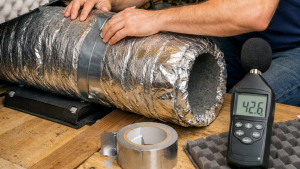
A duct running through an unconditioned attic or basement without proper insulation is essentially a heat exchanger working against you. In summer, the conditioned air inside picks up heat from the surrounding space before it ever reaches the register. In winter, the reverse happens. Either way, you’re paying to condition air that partially unconditions itself in transit.
The standard recommendation is R-6 to R-8 insulation for ducts in unconditioned spaces, with continuous coverage — no gaps, no compression at supports. Any section that’s exposed or improperly wrapped is a weak point in the system.
4.Wrong Placement of Vents and Registers
A register positioned next to a thermostat will cause the system to read the supply air temperature instead of the room temperature, triggering premature shutdowns and leaving the rest of the space under- or over-conditioned. A vent blocked by furniture or installed behind a door that’s always open is dead airflow — the system is working, but that corner of the room isn’t getting served.
Placement decisions need to account for how the space is actually used, not just how it looks on a floor plan. Thermostats belong away from supply registers, return grilles need clear paths, and supply vents should be positioned where air can move freely into the occupied zone.
5. Ignoring Static Pressure
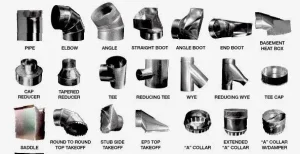
Static pressure is the resistance the duct system creates against airflow. Every fitting, every bend, every length of duct adds to it. When total static pressure exceeds what the air handler is rated to overcome, airflow drops across the whole system — not just in the longest run, but everywhere.
The consequence is a system that looks complete on paper but consistently underperforms. The fix requires measuring static pressure at both supply and return with a manometer, then comparing against the equipment’s rated external static pressure. If the number is too high, the cause needs to be identified — whether it’s an undersized trunk, too many fittings, or a return path that can’t keep up with supply.
6.Skipping Dampers for Zone Control
In any building with more than one thermal zone — different floors, different orientations, spaces with different occupancy patterns — a single-zone duct system without dampers will always leave someone uncomfortable. The system can only respond to one thermostat at a time, which means it’s constantly overcooling one area while undercooling another.
Dampers allow airflow to be balanced and directed. Motorized dampers connected to a zoning control system take that further, enabling independent temperature control in each zone without running separate systems. The upfront cost is real, but so is the energy and comfort benefit over the life of the installation.
7.Ignoring Air Leakage at Joints and Seams
Air leakage is the most consistently underestimated problem in duct systems. Joints that aren’t properly sealed, seams that were sealed at installation but have dried out over time, connections at registers and boots that were never tight to begin with — all of these bleed conditioned air into wall cavities, ceiling plenums, and unconditioned spaces where it does nobody any good.
The right sealing materials matter. Mastic sealant and UL 181-rated foil tape are the standard — not duct tape, which dries out and fails within months in a thermal cycling environment. On existing systems with significant leakage, aerosol-based internal sealing can address leaks that would otherwise require opening up the ductwork to reach.
8. Neglecting Ongoing Maintenance
Duct systems don’t stay in the condition they were installed in. Dust and debris accumulate over time, insulation gets damaged, seals that were tight at installation work loose as the building settles and thermal cycling stresses the connections. A system that was well-designed and properly installed will still degrade without regular attention.
Maintenance doesn’t have to be complex: annual inspection of accessible duct runs, static pressure and airflow checks, resealing any joints that show signs of leakage, and replacing insulation that’s wet, torn, or missing. The goal is catching small problems before they compound into expensive ones.
4. How to Get Duct Design Right From the Start
Most of the mistakes above share a common root: decisions made too quickly, without the right calculations or the right questions asked upfront. The standards exist for a reason — Manual J for load calculations, Manual D for duct sizing and design, SMACNA for construction and sealing requirements. Using them isn’t optional if the goal is a system that performs as designed.
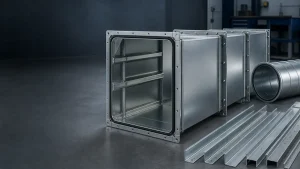
The other factor is the equipment itself. Duct fabrication quality directly affects how well a designed system performs in the field. Poorly fabricated ductwork — inconsistent dimensions, weak seams, rough interior surfaces — introduces friction losses and leakage points that no amount of design work can fully compensate for.
5. Conclusion
Good duct design is not about avoiding a checklist of mistakes — it’s about understanding how each decision affects system performance, and making those decisions deliberately rather than by default. The eight issues covered here are the ones that show up most often in underperforming systems, and most of them are entirely preventable with the right approach upfront.
If you’re working on a duct fabrication project and want equipment that supports consistent output quality, explore Durmahvac’s range of spiral duct machines and rectangular duct machines, or contact our team to discuss your specific production requirements.