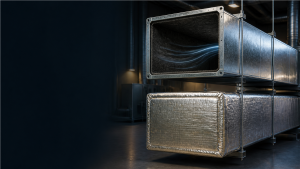
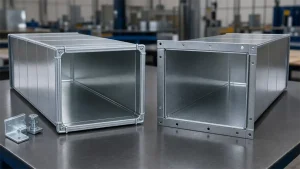
The core distinction is location. Duct liner is installed on the interior surface of the duct, in the airstream. Duct wrap is applied around the outside of the duct, typically after the duct is installed. Because each sits in a different position and interacts with different conditions, they serve different primary functions.
| Duct Liner (Inside) | Duct Wrap (Outside) | |
|---|---|---|
| Position | Bonded to the duct interior wall | Wrapped around the duct exterior |
| Installed | Typically during duct fabrication | On site, after duct installation |
| Primary function | Sound absorption within the duct | Thermal insulation and condensation control |
| Acoustic role | Absorbs airborne noise inside the duct | Minimal in-duct absorption; some breakout-noise reduction |
| Thermal role | Provides some thermal resistance | Main thermal barrier between duct and surrounding space |
| Key design check | Airstream erosion rating; effective internal dimensions | Continuous vapor-retarder facing; no compression |
Neither product seals duct joints. Insulation addresses heat transfer and acoustic performance — it does not replace proper air-sealing at seams and connections.
2. What Are Duct Liner and Duct Wrap Used For?
2.1 Duct Liner: Acoustic and Thermal Performance
Duct liner’s primary job is to absorb sound traveling through the duct system. The porous structure of fiberglass or acoustic foam liner converts acoustic energy as air passes over its surface, reducing fan noise, turbulence at fittings, and cross-talk between rooms connected to the same duct run.
Acoustic performance is commonly expressed using the Noise Reduction Coefficient (NRC) or Sound Absorption Average (SAA). NRC provides a single-number indication of sound absorption across four specified frequencies (250, 500, 1000, and 2000 Hz), while SAA averages absorption coefficients across a broader frequency range. Higher values generally indicate greater sound absorption, but actual duct attenuation also depends on liner thickness, duct geometry, airflow conditions, and frequency. Always consult manufacturer test data for the specified product and thickness — do not select liner based on density alone.
Liner also provides thermal resistance as a secondary benefit. Some 1-inch fiberglass liner products are rated around R-4.2, though actual values vary by manufacturer and product specification. This thermal contribution should be considered separately from the product’s primary acoustic function.
2.2 Duct Wrap: Thermal Insulation and Condensation Control
Duct wrap is designed for thermal insulation — limiting heat gain into a cold supply duct or heat loss from a heated duct. The thicker the insulation and the lower its thermal conductivity, the higher the R-value and the better the thermal performance.
Condensation control is closely linked to thermal performance. When a cold duct runs through a warm, humid space, moisture in the surrounding air can condense on the duct surface. A properly designed and installed wrap assembly — including a continuous, unbroken vapor-retarder facing — reduces the temperature differential at the duct surface and limits moisture migration. The facing is not decorative; it is a functional part of the assembly.
Wrap does reduce some sound radiated through the duct wall (breakout noise), but this is a secondary effect. It does not absorb sound traveling inside the duct — that path is unaffected by exterior insulation.
3.When to Use Duct Liner
Duct liner is worth evaluating when in-duct sound is the design requirement. Typical situations include:
- Downstream of fans and air handlers. The first several feet of duct leaving a fan or AHU carries the highest acoustic energy. Lining this zone reduces fan noise before it propagates through the duct system.
- Near noise-sensitive spaces. Offices, patient rooms, conference spaces, classrooms, and hotel rooms often have Noise Criteria (NC) targets. Lined duct sections in these zones may help attenuate airstream noise, though the required lining length, thickness, and configuration should be determined through acoustic calculations rather than assumed from a short installation section alone.
- At duct fittings. Elbows, tees, and transitions generate turbulent noise. Lined sections downstream of these fittings can reduce propagation, though liner is one element of a broader acoustic system that may also include silencers, sound attenuators, and duct geometry.
- Cross-talk prevention. In ceiling plenums where multiple rooms share a supply system, lined duct sections can reduce sound transmitted between spaces through the ductwork.
Design considerations:
Liner reduces the duct’s effective internal dimensions. A 1-inch liner on a 12-inch duct reduces the inside diameter or width by 2 inches (1 inch per side). This increases air velocity and pressure drop for a given airflow rate. When specifying lined duct, size the sheet-metal casing to account for the liner thickness and maintain the required free area.
Installation is typically done in the shop during fabrication, using adhesive and mechanical pins. Fiberglass duct liner should be evaluated against ASTM C1071, which covers key material properties including thermal conductivity, sound absorption, erosion resistance, and moisture-related performance. Product selection should be based on the manufacturer’s test data and the applicable edition of the standard. The airstream surface must withstand the system’s design air velocity — confirm erosion-resistance test data covers the specified conditions. Cut edges and joints should be sealed per the manufacturer’s instructions.
Retrofitting liner into existing ductwork is usually impractical. If the system is already installed and in-duct acoustic treatment is needed, duct silencers and sound attenuators installed at accessible duct sections are the standard retrofit approach.
4. When to Use Duct Wrap
Duct wrap is appropriate when heat transfer or exterior condensation is the primary concern. Common scenarios include:
- Ducts in unconditioned spaces. Supply and return ducts running through attics, crawl spaces, mechanical rooms, or exterior walls lose or gain heat proportional to the temperature difference. Wrapping these ducts reduces energy loss and helps maintain supply-air temperature at the register. Building energy codes typically set minimum R-value requirements for ducts in these locations — confirm the applicable code for the project.
- Condensation-prone environments. Cold supply ducts in humid climates or high-humidity interior spaces are at risk for surface condensation. The required insulation thickness should be determined by the duct operating temperature and the surrounding environmental conditions, including ambient temperature, relative humidity, dew point, and vapor-retarder continuity. R-6 or R-8 products may be suitable for some applications, but the required specification should be verified through project-specific calculations rather than general assumptions.
- Retrofit and renovation projects. When existing ductwork cannot be accessed internally, wrap is the practical insulation option. It can be applied to installed ductwork without disassembly.
- Code compliance upgrades. Energy retrofit programs and code-mandated improvements often require upgrading the insulation on existing duct runs. Wrap is the standard approach for accessible metal ductwork.
Installation checks:
The facing on duct wrap serves as the vapor retarder. Every joint, overlap, puncture, and penetration must be sealed with appropriate tape — typically aluminum foil tape rated for the application. Gaps or tears in the facing create a path for vapor to reach the cold duct surface and condense inside the insulation, degrading both thermal performance and potentially the duct itself over time.
Do not compress the insulation at corners, duct supports, hangers, or banding. Compressed insulation delivers a lower effective R-value at that point, and those spots are often where condensation problems first appear. Cut the wrap to the correct stretch-out length and plan for added clearance around the duct exterior.
5. Can You Use Duct Liner and Duct Wrap Together?
Yes, and in commercial HVAC it is relatively common. The two products address different paths — liner handles in-duct sound, wrap handles the external thermal and condensation load — so combining them makes sense when both requirements are present on the same duct run.
A typical scenario: a supply duct runs through an unconditioned ceiling plenum before serving a noise-sensitive patient floor. The design might call for 1-inch fiberglass liner inside (for acoustic performance) and R-6 wrap outside (for thermal performance and condensation control, subject to project-specific verification). The two layers do not interfere with each other, but the design needs to account for both the reduced internal dimensions from the liner and the added exterior envelope from the wrap.
Coordination checklist for combined assemblies:
- Size the metal casing to maintain the required free area after liner is installed.
- Confirm the total exterior build-up fits within clearances and does not conflict with supports or adjacent equipment.
- Verify vapor-retarder continuity on the wrap is not compromised by support hardware or liner installation.
- Confirm that liner and wrap products are compatible in terms of adhesives, facings, and temperature ratings.
- Verify the combined thermal performance against project requirements using manufacturer data for each product — do not assume values are simply additive.
A combined liner-plus-wrap assembly is not automatically required. Apply it only where the design calls for both acoustic and thermal/condensation performance on the same duct section.
6. Duct Liner vs. Duct Wrap: Installation and Cost Comparison
Material price per square foot is the starting point, not the full picture.
| Cost Factor | Duct Liner | Duct Wrap |
|---|---|---|
| Installation stage | Shop fabrication (before delivery) | Field installation (after duct is installed) |
| Labor consistency | Predictable; done by fabricator under controlled conditions | Varies by field access, duct geometry, and crew experience |
| Retrofit suitability | Generally not practical on installed duct | Standard approach for existing systems |
| Effect on duct dimensions | Increases sheet-metal casing size (additional material cost) | Increases exterior envelope (clearance planning required) |
| Rework risk | Low once fabricated; errors caught at the shop | Higher if facing is damaged, compressed, or improperly taped on site |
| Maintenance | No field maintenance required | Vapor-retarder integrity should be checked if accessible |
The apparent material-cost advantage of wrap can narrow or disappear once labor, access constraints, staging, and schedule are factored in. Lined duct costs more to fabricate, but it arrives on site ready to install with no additional field insulation step. For renovation or retrofit work where the duct is already in place, wrap is the available option regardless of cost comparison.
Request project-specific estimates based on actual quantities, accessibility, and specification requirements. Generic per-foot comparisons from product literature rarely reflect total installed cost.
7. How Duct Type and Operating Conditions Affect Selection
The duct liner vs. duct wrap comparison applies straightforwardly to standard rectangular metal duct. For other geometries and conditions, the decision requires additional review.
7.1 Spiral and Round Duct
For spiral and round duct, three insulation approaches are worth comparing:
- External duct wrap — applied around the outside, using the same principle as for rectangular duct. Practical for thermal insulation and condensation control on spiral runs.
- Internal spiral duct liner — purpose-designed liner products for round geometry, sometimes pre-kerfed boards that flex into place. Provides both sound absorption and some thermal resistance. Installation requires more care than flat rectangular sections, and small-diameter ducts (roughly 10 inches and under) can make internal liner installation difficult.
- Double-wall spiral duct — factory-fabricated with insulation between a perforated inner liner and an outer shell. Provides acoustic and thermal performance in a pre-assembled form and is well-established in SMACNA guidance. Useful when both performance requirements need to be met without field-applied liner.
The key point for spiral duct is that the choice is not simply liner versus wrap. Each option has different fabrication, installation, weight, and performance trade-offs. For spiral duct fabrication, the construction method influences which insulation approach is practical from the start.
7.2 High-Pressure and High-Velocity Systems
Higher system pressures and velocities place additional demands on duct liner. Liner must be rated for the design airstream conditions — check erosion-resistance test data, not just density or product category. Mechanical pinning becomes more critical, and some high-pressure applications specify a perforated metal facing over the liner surface for additional protection.
7.3 Temperature and Humidity Conditions
Standard fiberglass duct liner products have temperature limitations — confirm the manufacturer’s rated range for the specific product and facing. For high-temperature exhaust ducts, liner materials with appropriate thermal ratings should be evaluated separately. In persistently humid environments where liner could become wet, closed-cell elastomeric foam liner offers better moisture resistance than open-fiber options, at higher cost.
For wrap, the vapor-retarder facing’s temperature and humidity ratings should match the installation environment, particularly in applications with large temperature differentials where condensation risk is highest.
8. Installation Standards and Compliance Requirements
Specifying liner or wrap is not complete until product data, installation details, and code requirements are verified for the actual project.
For both products:
- Confirm thermal performance (R-value at installed thickness and conditions) against project requirements — not just labeled values at standard test conditions.
- Verify fire and smoke test results match project requirements; in the U.S., NFPA 90A references ASTM E84/UL 723 for flame-spread and smoke-developed ratings — confirm that submitted products have results satisfying the adopted code and local jurisdiction requirements.
- Coordinate insulation details with duct support, access panel, and clearance requirements.
For duct liner specifically:
- Evaluate the product against ASTM C1071, which covers thermal conductivity, sound absorption, erosion resistance, and moisture-related properties for fiberglass duct lining insulation; confirm the applicable edition and the project’s specification requirements.
- Review the manufacturer’s installation instructions for adhesive type, pin spacing, edge sealing, and facing details.
- Ensure the sheet-metal casing dimensions account for liner thickness; a liner installed in an undersized casing compresses and loses both acoustic and thermal performance.
For duct wrap specifically:
- Confirm vapor-retarder facing class and permeance rating match the design intent.
- Specify the correct overlap and joint-sealing tape — compatibility with FSK facings varies by temperature and humidity conditions.
- Document the minimum installed R-value requirement clearly; compression at corners and supports reduces actual R-value below the labeled value.
Insulation approval does not address duct air leakage. Where the system requires duct leakage testing per SMACNA or energy-code provisions, that is a separate scope item. For projects involving rectangular duct fabrication or spiral duct manufacturing, insulation specifications should be confirmed at the design stage rather than resolved in the field.
9. How to Choose: A Quick Decision Guide
| Project requirement | Recommended approach | Key consideration |
|---|---|---|
| Reduce noise traveling inside ducts | Duct liner | NRC/SAA rating, liner thickness, duct geometry, acoustic calculations |
| Reduce heat gain or heat loss | Duct wrap | Required R-value per code and project design |
| Prevent exterior condensation | Duct wrap with continuous vapor-retarder facing | Dew point, ambient RH, facing continuity, installation quality |
| Control both noise and heat transfer | Liner + wrap (combined assembly) | Internal dimensions, external clearance, product compatibility |
| Insulate existing ductwork | Duct wrap | Access and retrofit conditions |
| Acoustically treat spiral ducts | Spiral liner or double-wall duct | Diameter, airflow, fabrication method |
| High-humidity or wet environments | Closed-cell elastomeric foam liner or engineered wrap system | Moisture resistance, vapor control, product ratings |
10. FAQ
Answer: No. Duct wrap reduces some breakout noise — sound that radiates through the duct wall into the surrounding space — but it does not absorb sound traveling inside the duct. If the goal is to reduce fan noise, turbulence noise, or cross-talk transmitted along the ductwork, only an interior lining material with an appropriate NRC or SAA rating addresses the problem. Exterior wrap alone will not meet an NC target in a noise-sensitive space.
Answer: Yes. When a duct run requires both acoustic attenuation inside the duct and external thermal or condensation control, both products can be specified together. The key design steps are sizing the metal casing to account for liner thickness, maintaining vapor-retarder integrity on the wrap, and confirming that all accessories are compatible with both products and the system conditions.
Answer: In limited cases, liner provides enough thermal resistance for the application — particularly on interior duct runs in conditioned spaces where the temperature differential is small. However, liner’s thermal R-value is secondary to its acoustic function and is typically lower than a full wrap assembly. For ducts in unconditioned spaces or wherever code requires a minimum R-value on the duct exterior, wrap is the standard solution. The two products should be evaluated against separate performance criteria rather than treated as thermal equivalents.
Answer: Liner installed on the interior wall raises the surface temperature exposed to the airstream, which can reduce the risk of condensation on the inner duct wall in some conditions. However, it does not control condensation on the outer surface of the duct — that requires external insulation with a vapor-retarder facing. In high-humidity environments, closed-cell elastomeric foam liner offers better inherent moisture resistance than open-fiber fiberglass liner, whose performance degrades if it becomes saturated.
Answer: In most cases, no. Liner requires access to the interior duct surface for adhesive application and mechanical pinning — straightforward in shop fabrication, but impractical on installed ductwork, especially in completed ceiling plenums. If in-duct acoustic treatment is needed on an existing system, [IL: duct silencers and sound attenuators] installed at accessible duct sections are the standard retrofit approach.
Answer: Yes. Liner reduces the effective internal cross-section by twice the liner thickness on each axis. A 1-inch liner in a 12-inch round duct reduces the effective diameter to 10 inches, increasing air velocity and pressure drop for a given airflow rate. When lined duct is specified, size the sheet-metal casing to maintain the design airflow at the required face velocity.
11. Conclusion
The duct liner vs. duct wrap decision is not primarily about which product costs less per square foot. It is about matching the insulation to what the duct system actually needs to do — control sound inside the duct, limit heat transfer to the surrounding space, manage condensation, or some combination of these.
Start with the performance requirements, not the product category. Liner addresses in-duct acoustics and secondary thermal resistance. Wrap addresses external thermal insulation and condensation control. Neither crosses into the other’s primary function in a way that changes the specification decision. For projects involving custom duct fabrication — whether rectangular ductwork or spiral systems — confirming the insulation approach at the fabrication stage avoids costly adjustments in the field.
Before approving any submittal, verify that the product data matches the project’s acoustic targets, R-value requirements, vapor-retarder class, and applicable fire ratings. That check is where most specification errors are caught before they become field problems.