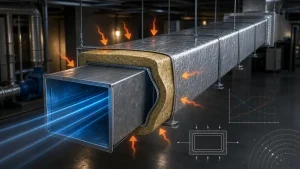
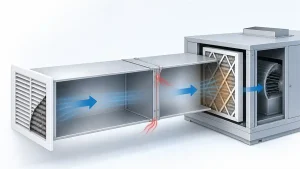

HVAC duct sizing is one of the most important steps in air distribution system design. If the duct is too small, airflow may be restricted, static pressure may rise, and the HVAC system may become noisy or inefficient. If the duct is too large, air velocity may drop, making air distribution less effective.
This HVAC duct size calculator helps you estimate round duct size, airflow capacity, rectangular duct equivalents, air velocity, and pressure drop. It is designed for HVAC contractors, engineers, duct fabricators, and workshop owners who need a quick reference before final design or fabrication.
As a professional HVAC duct machine manufacturer, Durmahvac not only provides duct sizing knowledge, but also helps customers choose suitable equipment such as spiral duct forming machines, auto duct production lines, and rectangular duct fabrication equipment based on duct size, material thickness, and production capacity.
1. CFM to Round Duct Size Calculator
Use this calculator when you know the required airflow and the target friction loss. Enter airflow in CFM and friction loss in in.wg per 100 ft, then the calculator will estimate the round duct diameter and air velocity.
A common friction loss value used for many HVAC duct sizing references is 0.10 in.wg/100ft, but the best value depends on system type, duct layout, pressure class, fittings, noise requirements, and engineering standards.
CFM to Round Duct Size Calculator
Enter airflow and friction loss to estimate the required round duct diameter and air velocity. This calculator uses a simplified ductulator-style friction loss calculation for quick reference.
3. What Is a Ductulator?
A ductulator is a tool used to estimate duct size, airflow, air velocity, and friction loss in HVAC duct systems. Traditional ductulators are often circular slide-rule tools, while modern ductulators can be built as online calculators.
In practical HVAC work, ductulators help contractors and engineers quickly compare airflow, duct diameter, velocity, and pressure loss. This makes duct sizing faster and reduces the chance of manual chart-reading errors.
4. How This HVAC Duct Size Calculator Works
This calculator estimates round duct size by matching the target friction loss entered by the user. It uses airflow, duct diameter, material roughness, Reynolds number, and friction factor to estimate pressure loss per 100 ft.
The calculation process is based on the relationship between:
- Airflow CFM
- Duct diameter
- Air velocity
- Friction loss
- Duct material roughness
Instead of asking users to enter a target velocity, this calculator finds a duct diameter that produces a friction loss close to the selected value. This is closer to the way many traditional ductulators are used in HVAC duct sizing.
5.Why Friction Loss Matters in Duct Sizing
Friction loss describes how much pressure is lost as air moves through ductwork. Higher friction loss means the fan must work harder to move the same amount of air. Lower friction loss can improve system performance, but it may require larger duct sizes.
A common reference value for many duct sizing examples is 0.10 in.wg/100ft, but this is not a universal rule. The best friction rate depends on the HVAC system type, available fan pressure, duct length, fittings, noise limits, and design standard.
6. CFM, Velocity and Round Duct Size Formula
Although this calculator uses friction-loss-based sizing, the basic airflow relationship is still important:
CFM = Area × Velocity
For a round duct, the cross-sectional area is calculated from the duct diameter. Once airflow and diameter are known, the calculator can estimate air velocity.
If the duct diameter is too small, velocity and friction loss increase. If the duct diameter is larger, velocity and friction loss decrease. A good duct design balances size, pressure loss, noise, installation space, and system performance.
7. Round Duct vs Rectangular Duct
Round ducts are often more efficient than rectangular ducts because they have a smoother airflow path and less surface area for the same airflow capacity. This can reduce friction loss and leakage risk in many HVAC systems.
Rectangular ducts are still widely used in commercial HVAC projects because they fit better into ceiling spaces, shafts, and limited installation areas. They are also common in large air distribution systems where rectangular sections are easier to coordinate with building layouts.
From a manufacturing perspective, round ducts are commonly produced by spiral duct forming machines, while rectangular ducts are commonly produced by auto duct production lines, lock forming machines, flange forming machines, and folding equipment.
8. Common HVAC Duct Size Reference Chart
The chart below provides a simple reference for common airflow values and approximate round duct sizes. Actual duct size should always be checked against friction loss, velocity, pressure drop, system layout, and professional design standards.
| Airflow CFM | Approx. Round Duct Size | Common Use |
|---|---|---|
| 100 CFM | 6 in | Small branch duct |
| 200 CFM | 8 in | Branch duct |
| 400 CFM | 10 in | Residential supply or return |
| 600 CFM | 12 in | Larger branch duct |
| 1000 CFM | 14 in | Main duct section |
| 1500 CFM | 16 in | Commercial duct section |
| 2000 CFM | 18 in or larger | Large main duct |
9.How Duct Size Affects Fabrication Machine Selection
Duct size is not only an engineering design factor; it also affects duct manufacturing equipment selection. Larger duct sizes may require wider coils, stronger forming capacity, larger working space, and more stable control systems.
For round duct production, the machine must match the required diameter range, material thickness, coil width, and production speed. A spiral duct forming machine is commonly used to produce continuous round spiral ducts with consistent diameter and seam quality.
For rectangular duct production, an auto duct production line can complete decoiling, leveling, beading, notching, cutting, locking, and flange forming. If a workshop produces multiple duct sizes every day, feeding accuracy, forming stability, and automation level become very important.
Durmahvac provides HVAC duct fabrication equipment for round, rectangular, and spiral duct production. If you are not sure which machine matches your duct size range, you can contact Durmahvac for machine selection support.
10. Why Proper Duct Sizing Matters
Proper duct sizing helps maintain balanced airflow, reduce pressure loss, control noise, and improve HVAC system efficiency. Undersized ducts can restrict airflow and increase static pressure, while oversized ducts may reduce air velocity and affect air distribution.
For duct fabricators, accurate duct sizing also helps improve production planning. When duct dimensions, material thickness, and connection methods are clear, it becomes easier to select suitable duct machinery and reduce fabrication errors.
A well-designed duct system still needs accurate fabrication. Stable duct forming, reliable seams, correct flange assembly, and consistent dimensions all help improve final HVAC installation quality.
11. FAQ
A ductulator is a tool used to estimate duct size, airflow, velocity, and friction loss in HVAC duct systems. Traditional ductulators are often slide-rule tools, while modern versions can be online calculators.
Many duct sizing examples use 0.10 in.wg/100ft as a reference value, but the correct friction loss depends on system design, fan capacity, duct length, fittings, noise requirements, and engineering standards.
Duct size can be estimated by combining airflow, friction loss, and velocity relationships. A ductulator finds a duct size that can carry the required CFM while staying near the selected friction loss.
In many cases, round duct is more efficient because it has less surface area and lower friction loss for the same airflow. However, rectangular duct is often used when ceiling space or building layout limits installation options.
No. This calculator provides reference estimates only. Final HVAC duct design should follow local building codes, project requirements, ACCA Manual D, SMACNA standards, and professional engineering review.
12. Conclusion
After calculating duct size, the next step is choosing the right fabrication equipment. Durmahvac manufactures HVAC duct machines for spiral duct, round duct, rectangular duct, and automatic duct production applications.
Whether you need a spiral duct forming machine, auto duct production line, flange forming machine, or complete duct workshop solution, our team can help you choose equipment based on duct size range, material thickness, production capacity, and budget.
If you need help planning your duct fabrication workshop, please contact Durmahvac. Our technical team can provide machine recommendations and production line configuration support.